Hydrotherapy
Cold Plunge vs Kneipp Hydrotherapy: What Actually Builds Resilience

By Rajesh Chada · Founder & CMD, The Ushmaya
20 September 2026 · 7 min read
Every month or so a guest arrives having already done six months of ice baths, tracked on a watch, and wants to know why our cold water is only knee-deep and lasts ninety seconds.
It is a fair question, and the answer gets to something the wellness internet has largely obscured. Ice baths and the Kneipp water cure both involve cold water. They are aimed at different outcomes, dosed on opposite principles, and carry different risks.
One is a stress-adaptation protocol. The other is a therapy. Knowing which you want determines everything.
The two philosophies
The cold plunge model. Deliberate, significant physiological stress to drive adaptation. The logic is hormesis — a dose of a stressor large enough to provoke an adaptive response, from which you emerge more robust. More is more, within tolerance. Progression means colder, or longer. The desired experience is difficulty overcome, and the mental training is a stated part of the benefit.
Typical dose: 2–5°C, five to fifteen minutes, whole body, two or three times a week.
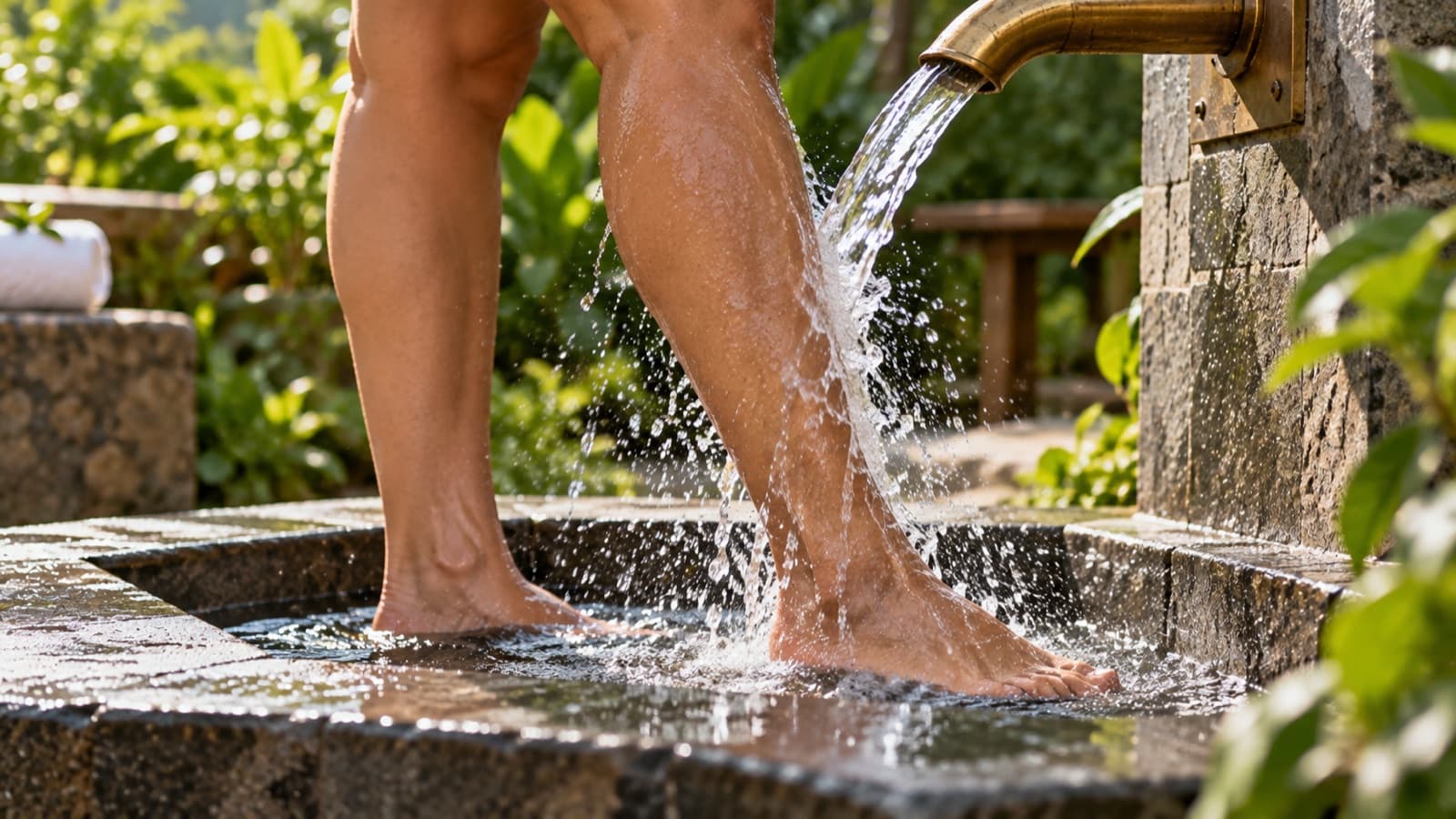
The Kneipp model. A brief, precise stimulus to provoke a reaction, followed immediately by reactive warming, repeated often. The logic is training through response rather than through strain. More is not more — the correct dose is the smallest one that produces a clean reaction, and the measure of success is how quickly you warm back up afterwards. The desired experience is pleasant, enlivening, and entirely repeatable tomorrow.
Typical dose: 12–18°C, thirty seconds to two minutes, often one limb or region at a time, once or twice daily.
The gap between those two is not a matter of degree. It is a different theory of how bodies improve.
Dose and frequency, side by side
| Cold plunge | Kneipp | |
|---|---|---|
| Temperature | 2–8°C | 12–18°C |
| Duration | 5–15 min | 30 sec–2 min |
| Coverage | Whole body | Often local — feet, calves, arms, face |
| Frequency | 2–3× weekly | 1–2× daily |
| Progression | Colder, longer | More often, better reaction |
| Afterwards | Rewarm passively, often slowly | Dry off and move immediately until warm |
| Aimed at | Adaptation, mental toughness | Circulation, nervous-system regulation, sleep |
| Primary population | Athletic, healthy | Anyone, including the unwell and the elderly |
That last row is the one that matters most to me. Kneipp treated tuberculosis patients, elderly villagers and sick children. A protocol that requires you to already be robust is not a therapeutic protocol — it is a performance one.
What each is genuinely good for
Cold plunging earns its reputation for:
- post-exercise recovery and reducing perceived soreness (with the real caveat below)
- a large, reliable dopamine and noradrenaline response — the hours-long lift afterwards is well documented
- building deliberate tolerance of discomfort, which is a genuine psychological skill
- brown adipose tissue activation with sustained regular exposure
Kneipp hydrotherapy earns its place for:
- sleep — the single most consistent effect we see, usually inside a week
- peripheral circulation: cold hands and feet, heavy legs, varicose discomfort
- nervous-system regulation in people who are already depleted
- recurrent minor infections and poor resilience
- pain and stiffness, alongside warm applications
- being appropriate for the elderly, the deconditioned and the chronically unwell
Notice they barely overlap. If you are a healthy 32-year-old lifting four times a week, plunging may well serve you. If you are a 50-year-old who hasn't slept properly since 2019, it is close to the worst thing you could add.
The two things the internet gets wrong
One: the recovery contradiction. Cold immersion immediately after resistance training appears to blunt the adaptive signalling that drives muscle growth. If you're training for strength or hypertrophy, an ice bath straight after your session may be working against you. For endurance recovery between same-day efforts, it's useful. The nuance gets lost because "cold = recovery" is a better slogan.
Two: more is not more. The dose-response curve for cold is not linear, and for most of the therapeutic benefits it flattens early. The circulatory and autonomic effects of thirty seconds at 15°C are not meaningfully inferior to five minutes at 4°C — and the second carries a cardiac risk the first does not. What does scale is frequency. Daily brief exposure beats weekly heroic exposure, reliably, for everything clinical.
Kneipp worked this out in the 1870s by treating tens of thousands of people and watching what happened. It is slightly dispiriting that it needs relearning.
The risks, stated plainly
Cold water is not benign, and the whole-body cold-shock response is where the danger sits.
Cold shock. Sudden whole-body immersion in very cold water triggers an involuntary gasp and uncontrolled hyperventilation. In a bathtub it's unpleasant; it is also the mechanism behind a significant proportion of cold-water drownings.
The cold pressor response. Blood pressure rises sharply and heart rate variability swings. In anyone with coronary disease, arrhythmia or uncontrolled hypertension this is a genuine cardiac risk, and it is the reason we require physician clearance before any whole-body cold work.
Afterdrop. Core temperature continues falling after you get out, as cold peripheral blood returns to the core. The longer and colder the immersion, the worse it is. This is why the Kneipp protocol insists on active rewarming by movement, and why sitting in a towel afterwards is a mistake.
Never alone. No one should do whole-body cold immersion unsupervised, and no one should combine it with breath-hold work — the combination of hyperventilation and cold water has killed people.
Do not do either if you have: cardiac disease or arrhythmia; uncontrolled hypertension; Raynaud's or cryoglobulinaemia; severe peripheral vascular disease or neuropathy with reduced sensation; epilepsy or a history of cold-induced fainting; advanced kidney disease; an acute febrile illness; or a pregnancy without specific guidance.
What we actually do
At Ushmaya cold work is prescribed, graded and supervised. In practice that means:
Week one is warmer than you expect. We start with knee affusions and the Kneipp walk at 16–18°C. Almost nobody goes into whole-body cold on day one, including the people who have been plunging for a year — because we are training a reaction, and the reaction has to be clean before the dose increases.
The breath leads. Long exhale into the cold. If you're gasping, the water is too cold or the exposure too long, and the therapist shortens it. Breath control is the skill being trained; the vagal mechanism is here.
Warm comes first, and cold comes last. Most of our cold work happens inside a contrast sequence — warm phase, short cold phase, always finishing cold, then movement. The mechanism is in contrast bath therapy.
Twice daily beats twice weekly. This is the whole design argument for a residential programme. The 3-Day Hydro Retreat gives six sessions in three days; the 7-Day Deep Healing Retreat gives enough frequency for genuine vascular adaptation.
And it is one of five pillars, not the whole thing. Kneipp's insistence that water alone was insufficient — that it needed movement, nutrition, herbs and ordered living alongside — is the part the plunge-tub industry has not inherited. The full framework is in our complete guide to hydrotherapy.
Which should you do?
Plunge if: you are healthy and well-conditioned, you train, you want the dopamine response and the mental practice, and you have cleared it medically. Keep it away from your strength sessions and never do it alone.
Do Kneipp if: you sleep badly, your hands and feet are cold, your legs ache, you catch everything going round, you are over fifty, you are recovering from something, or you are exhausted. Which, for the record, is most people who write to us.
And if you're already plunging but sleeping badly — that is worth sitting with. A nervous system in sympathetic overdrive does not need more arousal, however virtuous it feels. Try swapping the weekly ice bath for a nightly thirty seconds of cold water on the feet and calves, followed by walking until warm, for two weeks. Watch your sleep rather than your watch.
If you want to know which dose is right for your blood pressure, your circulation and your history, that's a consultation, not an article. Ours are free.
Written by
Rajesh Chada
Founder & CMD, The Ushmaya
Rajesh is the founder of The Ushmaya and the reason Kneipp hydrotherapy exists in India. He writes about water cure, Ayurveda and what genuine healing asks of you.
About Rajesh→A note on medical advice. This article is written for general understanding and is not a diagnosis or a treatment plan. Hydrotherapy, Panchakarma and fasting protocols are powerful and are not appropriate for everyone — particularly during pregnancy, or with cardiac, renal, circulatory or acute conditions. Every therapy at Ushmaya is prescribed after a consultation with our resident physicians. Please speak to your own doctor before changing how you treat a diagnosed condition.