
Hydrotherapy
Hydrotherapy in India: A Complete Guide to the Kneipp Water Cure
By Rajesh Chada · Founder & CMD, The Ushmaya
1 September 2026 · 9 min read
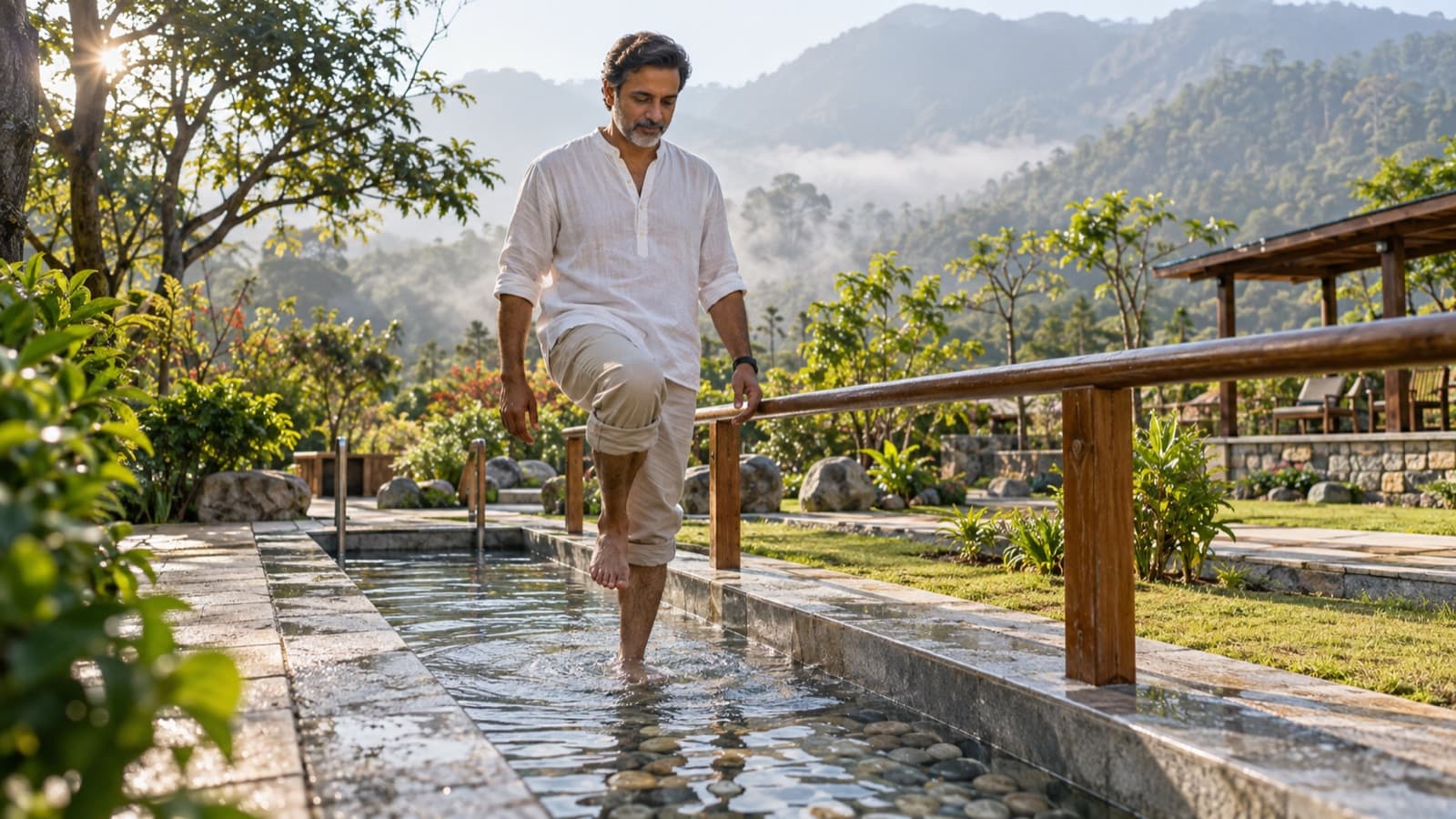
Every few weeks someone arrives at Ushmaya expecting a spa. They have seen the word hydrotherapy and pictured a jacuzzi with coloured lights. By the second morning they are standing shin-deep in cold water at 6am, walking like a stork across a pebbled trough, and asking me why nobody told them water could do this.
So let me tell you properly.
Hydrotherapy is the use of water — its temperature, its pressure, where it touches you and for how long — as a clinical tool. It is one of the oldest medical practices we have, and in its modern form it is barely 150 years old, codified by a Bavarian priest who very nearly died of tuberculosis and cured himself in a freezing river. It is not a treatment you order from a menu. It is a prescription.
This guide is the long answer to the question I get asked most: what is hydrotherapy, and will it do anything for me?
What hydrotherapy actually is
Strip away the marketing and hydrotherapy rests on something simple. Your body is extremely good at regulating its own temperature, and it does so largely through blood — moving it toward the skin to shed heat, pulling it into the core to conserve it.
Apply cold water to the skin and the vessels beneath constrict, driving blood inward. Apply warmth and they dilate, drawing blood out. Alternate the two in a controlled sequence and you are not relaxing the circulatory system — you are training it. The vessels contract and release like any other muscle that has been asked to work.
Three things happen alongside that:
- The nervous system shifts. A brief, controlled cold stimulus produces a sharp sympathetic response — the gasp, the alertness — followed by a pronounced parasympathetic rebound. That rebound is the part people feel for hours afterwards and struggle to name. It is the opposite of a caffeine high. It is the body standing down.
- Lymph moves. Lymph has no pump of its own; it depends on muscle contraction and vascular tone. Thermal contrast and water pressure both help shift it.
- Breathing changes. Cold water on the chest or the back of the neck forces a slow, deliberate exhale. You cannot panic and breathe well at the same time, and learning that under cold water is a lesson that transfers to the rest of your life.
None of this requires a machine. It requires water, a thermometer, a sequence, and someone who knows what they are doing.
Sebastian Kneipp and the five pillars
Father Sebastian Kneipp was a young seminarian in 1840s Bavaria with advanced tuberculosis and no prospects. He found an old book on the curative powers of cold water, began bathing in the Danube in winter, and recovered. He then spent the next five decades treating tens of thousands of people and, crucially, refusing to believe water alone was the answer.
What he built instead was a system of five pillars, and this is the part most modern wellness borrows from without crediting:
- Hydrotherapy — water applied with precision.
- Movement — purposeful physical activity, not exhaustion.
- Nutrition — simple, seasonal, whole food.
- Herbs — plant medicine as support, not spectacle.
- Balance — order, rhythm, rest, and inner life.
Read that list again and ask yourself how closely it maps onto Ayurveda. Jala chikitsa (water therapy), vyayama (movement), ahara (diet), aushadhi (herbal medicine), dinacharya and sadvritta (daily rhythm and right living). Two traditions, two continents, eight thousand kilometres apart, arriving at the same five answers.
That overlap is not a coincidence, and it is the reason Ushmaya exists. We did not import a European therapy into India. We found the European articulation of something this valley already knew, and put the two in the same building.
The therapies, one by one
Here is what a hydrotherapy prescription is actually made of. Our hydrotherapy page lists the full suite; this is what each one is for.
Kneipp affusions. A smooth, pressureless stream of cold water run over a specific part of the body in a specific order — up the outside of the leg, down the inside, never randomly. Knee affusions for circulation and sleep. Arm affusions, the famous "cold espresso", for alertness without stimulants. Face affusions for headache and tension.
The Kneipp walk. Shin-deep cold water, a stork-like walking gait, two to five minutes, then dry off and move until you are warm again. It looks faintly ridiculous. It is also one of the most effective things you can do for heavy, aching legs, varicose discomfort and poor sleep — and it is the single therapy almost everyone takes home.
Contrast baths. Alternating warm and cold immersion of the limbs or the whole body, always finishing cold. This is the vascular training exercise, and it is the backbone of our circulation work. I have written separately on why contrast baths reset the nervous system.
Sitz baths. A pelvic bath, warm or cold or alternating. Unglamorous, old-fashioned, and remarkably useful for pelvic circulation, menstrual pain and lower-back tension. Kneipp used them constantly.
Mineral and herbal immersion. Warm water carrying mineral salts or herbal decoctions — for musculoskeletal pain, skin conditions and the plain luxury of warmth after a week of cold.
Supervised cold exposure. Short, measured, monitored. This is the therapy most abused by the internet and the one we are strictest about.
Wraps and compresses. Cloth, water, time. A calf wrap brings down a fever. A chest wrap loosens a cough. A liver compress is the most reliably sedating thing I have ever experienced.
What a day of it feels like
Honestly? Day one is uncomfortable, day two is worse, and day three is the reason people come back.
The first morning your body treats cold water as an emergency. You hold your breath, your shoulders climb, you want it over. Our therapists spend most of that session on breathing rather than water.
By the second day the cold still bites but the panic has gone. You will probably sleep ten hours and feel wrung out — that is the parasympathetic rebound arriving all at once, and it is also why we pair early hydrotherapy with gentle yoga rather than hard practice.
Somewhere on day three something turns over. The water stops being an ordeal and becomes a tool. Guests start asking for the walk instead of enduring it. Appetite normalises. The 3am waking stops. This is the shift we design the 3-Day Hydro Retreat around, and the reason I tell people that two nights is the floor, not the ideal.
Give it a week — the length of our 7-Day Deep Healing Retreat — and you are no longer reacting to therapies, you are adapting to them. That is when circulation, digestion and sleep start moving together rather than separately.
Who it suits, and who it does not
Hydrotherapy is remarkably broad in application, which is exactly why honesty about its limits matters.
It tends to help most with:
- chronic stress, burnout and the wired-but-exhausted state
- poor or broken sleep
- sluggish circulation, cold hands and feet, heavy legs
- stubborn low-grade inflammation and joint stiffness
- recurrent minor infections and poor resilience
- metabolic sluggishness, alongside nutrition and movement — the basis of our Metabolic Balance & Weight Reset
- recovery after a long period of overwork
It is not appropriate, or needs significant modification, if you have:
- cardiac disease, uncontrolled hypertension or arrhythmia
- Raynaud's, cryoglobulinaemia or severe peripheral vascular disease
- advanced kidney disease
- an acute infection with fever (some wraps apply; immersion does not)
- a pregnancy — much is possible, much is not, and none of it should be guessed at
- epilepsy, or any condition where a vasovagal response is dangerous
This is also why cold exposure at Ushmaya happens with a physician's clearance and a therapist present. The internet's version of cold therapy — longer, colder, braver — is a different activity with a different risk profile, and I have written about where it diverges from the Kneipp tradition.
Why Rishikesh, and why September
Water therapy needs good water and a reason to stay outdoors, and this stretch of the Ganges at Haripur Kalan has both. The air is clean enough that breathwork is pleasant rather than theoretical. Mornings are cool even in summer. And the river sets a rhythm that no sound system can reproduce.
Season matters more than people expect. Through the monsoon the air is heavy and the body holds damp; by late September that lifts, the light sharpens, and — in Ayurvedic terms — accumulated pitta starts to aggravate. It is the classic window for cooling, clearing therapies, which is precisely what hydrotherapy is. If you want the long version, read Sharad Ritu: the Ayurvedic guide to September.
Practically: late September through November is the best stretch we have. The weather is kind, the gardens are still green from the rains, and the valley is not yet cold enough to make 6am cold water a genuine act of courage.
What to do with this
If you take one thing from this guide, make it this: hydrotherapy is not a luxury add-on to a holiday. It is a practice, it works by repetition, and it works fastest when the other four pillars are in place at the same time. That is the entire argument for doing it in a residential setting rather than in your bathroom on a Tuesday.
That said, start in your bathroom on a Tuesday. Finish your shower with thirty seconds of cold water on your feet and calves, then dry off and walk around until you are warm. Do it for two weeks. If your sleep changes — and for most people it does — you will understand why a priest in Bavaria thought he had found something.
When you want the full prescription rather than the fragment, book a consultation. Tell us how you sleep, how you digest, how long you have been running on fumes. We will tell you honestly whether three days, a week or a fortnight is the right ask — and if this isn't the right moment for you, we will tell you that too.
Written by
Rajesh Chada
Founder & CMD, The Ushmaya
Rajesh is the founder of The Ushmaya and the reason Kneipp hydrotherapy exists in India. He writes about water cure, Ayurveda and what genuine healing asks of you.
About Rajesh→A note on medical advice. This article is written for general understanding and is not a diagnosis or a treatment plan. Hydrotherapy, Panchakarma and fasting protocols are powerful and are not appropriate for everyone — particularly during pregnancy, or with cardiac, renal, circulatory or acute conditions. Every therapy at Ushmaya is prescribed after a consultation with our resident physicians. Please speak to your own doctor before changing how you treat a diagnosed condition.