
Hydrotherapy
Contrast Bath Therapy: Why Hot and Cold Water Resets the Nervous System

By Rajesh Chada · Founder & CMD, The Ushmaya
10 September 2026 · 7 min read
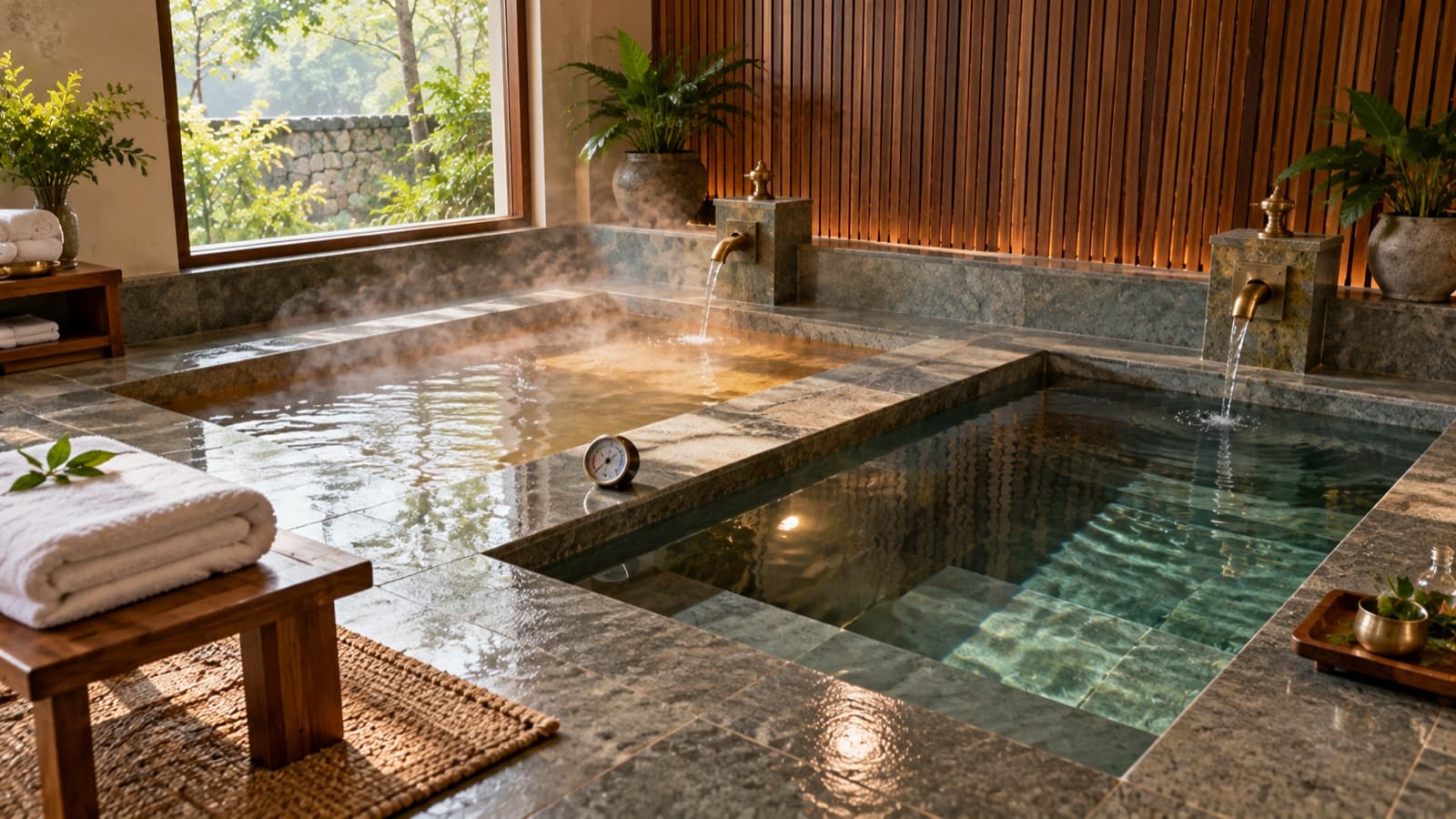
If I had to keep one therapy and throw away the rest of the building, it would be this one.
Contrast bathing is the least glamorous thing we do. There is no oil, no incense, no music. There are two tubs — one warm, one cold — a timer, and a therapist telling you to breathe out. And it is the therapy guests ask to take home more often than any other.
Here is why it works.
The mechanism, honestly
Your blood vessels are not passive tubes. The small arteries and arterioles have smooth muscle in their walls, and that muscle contracts and relaxes constantly to direct blood where it is needed.
Heat makes it relax — vasodilation. Vessels open, blood floods to the skin, you flush, you shed heat.
Cold makes it contract — vasoconstriction. Vessels narrow, blood is driven inward to protect the core, the skin goes pale.
Do one, and you get one effect. Alternate them, and you are asking that smooth muscle to contract and release, repeatedly, under load. In other words: you are exercising the vascular system. Practitioners have called it vascular gymnastics for a century, and it remains the clearest description.
Three consequences follow.
1. Circulation improves in the places it is worst. The hands, feet and lower legs are where poor peripheral circulation shows up first — cold extremities, heavy aching legs, slow healing, numbness. Contrast therapy targets exactly that territory, which is why we use it so heavily in chronic pain work.
2. Stagnation moves. Lymph has no pump. It depends on muscle contraction, vascular tone and external pressure. Alternating thermal stress supplies all three, and the effect on swelling and post-exertion heaviness is immediate and obvious.
3. The nervous system is forced through a full cycle. This is the part that matters most, and it is the part the fitness world ignores.
The autonomic swing
Cold immersion produces an unmistakable sympathetic surge. Sharp inhale, heart rate up, catecholamines released, attention narrowed. For a few seconds you are in a mild, controlled stress response.
Then — and this is the therapeutic event — you come out, and the parasympathetic rebound arrives. Heart rate drops below where it started. Vessels re-dilate. Breathing lengthens on its own. Heart rate variability rises.
That rebound is the thing. You are not relaxing despite the cold; you are relaxing because of it. A system that has been held in low-grade sympathetic activation for years often cannot find its way to the parasympathetic side by being asked nicely. Push it hard and briefly in the other direction and the rebound does the work for you.
Which is why, counter-intuitively, we use cold water with people who arrive wired and exhausted rather than with the athletic. The mechanism is the same one breathwork reaches more slowly — I've written about the vagus nerve and why the exhale is a lever. Cold water is simply the blunter instrument, and it does not require you to be good at anything.
The protocol
This is the structure, and the details are not decoration.
Warm phase. 38–40°C. Three to four minutes. Long enough for genuine dilation; not long enough to make you sleepy.
Cold phase. 12–18°C. Thirty seconds to one minute. Short. The error everyone makes is going longer, which produces endurance rather than response.
Ratio. Roughly 3:1 or 4:1 warm to cold.
Cycles. Three to five.
Always finish cold. This is the rule people break and then wonder why they feel flat. Finishing warm leaves the vessels dilated and the body shedding heat, which produces drowsiness and a chilled hour afterwards. Finishing cold leaves them constricted, then rebounding, which produces the warm, settled, quietly energised state that is the whole point.
Then move. Dry off properly and walk, or do gentle movement, until you are warm from the inside. Do not get into a dressing gown and sit still. The reactive warming is part of the therapy, not the aftermath.
Breathe out. Long exhale into the cold. Never hold your breath. If you are gasping, the water is too cold or the phase is too long.
Where to do what
Hands and forearms, feet and lower legs. The gentlest and most useful version. Two buckets, kitchen floor, no equipment. This is what we send people home with.
Lower legs to the knee. Best for heavy legs, varicose discomfort, standing all day, and poor sleep. The Kneipp knee affusion is the elegant version of the same thing.
Full body. Most powerful, most demanding, and the one that needs supervision and a physician's clearance.
The Kneipp walk. Shin-deep cold water, high stork-like steps, two to five minutes, then dry off and walk. Technically not a contrast bath, but it reaches the same territory and it is the therapy almost everyone adopts permanently. Our hydrotherapy suite is built around it.
The five mistakes
In order of how often I see them:
- Too long in the cold. You want a response, not a test of character. Thirty to sixty seconds.
- Finishing warm. Undoes most of the benefit.
- Not moving afterwards. Reactive warming is the therapy completing itself.
- Holding the breath. Guarantees you will dread it and won't continue.
- Doing it once a fortnight. Vascular tone is trainable, and like every trainable thing it responds to frequency. Four times a week with warm feet beats once a week in an ice bath.
Who should not
Contrast therapy is broadly safe and specifically dangerous for a handful of people. Do not do this without medical clearance if you have:
- cardiac disease, arrhythmia or uncontrolled hypertension — the cold pressor response raises blood pressure sharply
- Raynaud's phenomenon or cryoglobulinaemia
- severe peripheral vascular disease, or peripheral neuropathy with reduced sensation (you cannot feel a cold injury coming)
- advanced diabetes with neuropathy — foot immersion in particular
- a pregnancy, without specific guidance
- epilepsy, or a history of fainting with cold
- an acute infection with fever, or an open wound in the area
And a word on the internet version: longer, colder and braver is a different activity. Ice baths at 3°C for fifteen minutes are a hormetic stress-adaptation protocol, not a therapy, and they carry a real cardiovascular risk profile. I've written about where cold plunging and the Kneipp tradition diverge — the short version is that the Kneipp dose is smaller, more frequent, and aimed at a different outcome.
Start tonight, for free
The entry-level version requires nothing:
In the shower. Finish with thirty seconds of cold water on your feet and calves only — not your head, not your chest. Then dry off and walk around the house until your feet are warm. Every evening for two weeks.
Two-bucket version. One bucket at 39°C to the ankle, one at 15°C. Three minutes warm, forty seconds cold. Four rounds. End cold. Then walk.
Watch one number: how long it takes you to fall asleep. In my experience that is where the change appears first, usually inside ten days, and it is far more reliable than how the session itself felt.
Why we do it residentially
Because the gains come from frequency, the temperatures have to be right, and the first three days are the ones most people would skip if left alone.
Twice a day for three nights is enough for the sleep change to arrive and for you to learn the protocol properly — the design of the 3-Day Hydro Retreat. A week is enough for circulation and digestion to begin moving together, and for the practice to stop feeling like an ordeal — the 7-Day Deep Healing Retreat.
The full picture of where contrast therapy sits in the Kneipp system is in our complete guide to hydrotherapy. And if you want to know whether it is appropriate for your particular circulation, blood pressure or pain, that is a conversation with a physician rather than an article — book one.
Written by
Rajesh Chada
Founder & CMD, The Ushmaya
Rajesh is the founder of The Ushmaya and the reason Kneipp hydrotherapy exists in India. He writes about water cure, Ayurveda and what genuine healing asks of you.
About Rajesh→A note on medical advice. This article is written for general understanding and is not a diagnosis or a treatment plan. Hydrotherapy, Panchakarma and fasting protocols are powerful and are not appropriate for everyone — particularly during pregnancy, or with cardiac, renal, circulatory or acute conditions. Every therapy at Ushmaya is prescribed after a consultation with our resident physicians. Please speak to your own doctor before changing how you treat a diagnosed condition.