
Mind, Breath & Sleep
The Vagus Nerve, Explained: Why Breathwork Does More for Burnout Than a Holiday

By Rajesh Chada · Founder & CMD, The Ushmaya
6 September 2026 · 7 min read
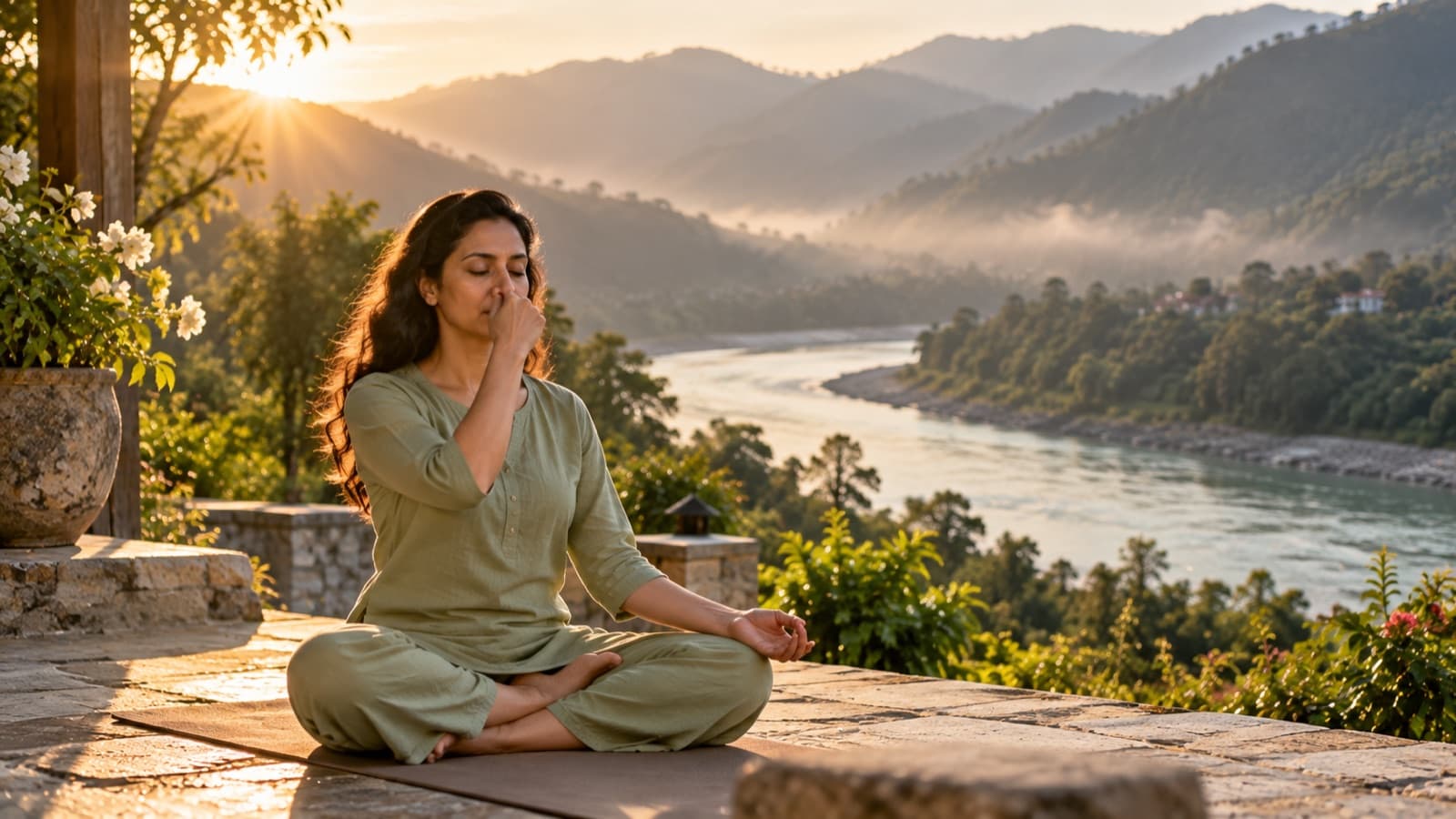
A guest told me last year that she had taken four holidays in eighteen months and come home from every one more tired than she left. She wasn't exaggerating and she wasn't ungrateful. She had simply discovered the thing nobody tells you about burnout: rest is not the same as recovery.
You can lie on a beach for a week with a nervous system that never once stands down. You can sleep nine hours a night and wake unrefreshed. You can be, in the exact phrase people use when they arrive here, exhausted but wired.
That state has a physiology, and understanding it changes what you do about it.
Two gears, and one of them is stuck
Your autonomic nervous system runs on two branches.
The sympathetic branch is the accelerator. Threat, deadline, confrontation, notification. Heart rate up, blood to the muscles, pupils wide, digestion paused, cortisol and adrenaline released. Brilliant engineering for a short emergency.
The parasympathetic branch is the brake. Rest, digest, repair, reproduce. Heart rate down, blood to the gut, immune function restored, tissue rebuilt, sleep deepened.
The design assumes you spend most of your life in the second and visit the first occasionally. Modern working life inverts that. And here is the part that matters: the sympathetic system does not switch off because the threat has passed. It switches off when something actively engages the brake. Absence of stress is not the same as presence of recovery.
The brake has a name. It is the vagus nerve.
What the vagus nerve actually is
Vagus means wandering, and it is well named. It is the tenth cranial nerve, it leaves the brainstem, and it wanders — to the throat, the heart, the lungs, the stomach, the liver, the intestines. It is the single largest nerve of the parasympathetic system and the main physical cable between your brain and your gut.
Roughly 80% of its fibres are afferent — carrying information up, from body to brain, not down. This is the detail most people miss, and it is the whole basis of breathwork. Your brain is constantly reading the state of your body through this nerve and deciding, on that evidence, whether you are safe.
Which means you can argue with your brain in a language it cannot ignore: the state of your own body.
How well that cable is working is broadly described as vagal tone, and it is measurable through heart rate variability — the small, healthy variation in the interval between heartbeats. High variability means a responsive, flexible system. Low variability means a system locked in one gear, and it tracks with poor sleep, anxiety, inflammation, digestive trouble and cardiovascular risk.
Why the breath is the one voluntary lever
Almost everything the autonomic system does is beyond your direct control. You cannot decide to lower your blood pressure or increase gastric secretion. Breathing is the exception — it is the one autonomic function with a full voluntary override.
And it is wired directly into vagal activity. Specifically:
- Inhalation briefly suppresses vagal output. Heart rate rises.
- Exhalation increases it. Heart rate falls.
You can feel this on yourself in thirty seconds. That rhythmic rise and fall is called respiratory sinus arrhythmia, and it is the mechanism behind every effective breathing practice ever devised: make the exhale longer than the inhale and you shift the balance toward the brake.
That is the entire secret. Everything else is refinement.
Two other things help:
- Slow down. Around five to six breaths per minute, the oscillations of breathing, heart rate and blood pressure come into phase and the system resonates. This is why most traditions independently arrived at roughly a ten-second breath cycle.
- Breathe low. Diaphragmatic breathing moves the viscera and stimulates vagal afferents mechanically. Chest-and-shoulder breathing does not, and it is what almost everyone does at a desk.
Four practices worth your time
Here is what we actually teach, in the order we teach it.
1. Extended exhale (do this one today). Inhale through the nose for four counts, exhale through the nose for eight. No breath holds, no strain. Five minutes. This is the floor of everything else and it is the practice I give to people who tell me they cannot meditate. You are not trying to relax. You are operating a lever.
2. Bhramari — the humming breath. Inhale normally; exhale with a low, sustained hum, lips closed, for as long as the breath lasts. The hum does two useful things: it enforces a very long exhale, and the vibration reaches vagal fibres in the larynx and pharynx directly. Six to eight rounds. It is also, for reasons I cannot fully explain, the single most reliable thing we have for people who cannot get back to sleep at 3am.
3. Nadi Shodhana — alternate nostril breathing. Slow, even, alternating. The best-studied pranayama for heart rate variability, and the practice most likely to produce a measurable change in a week. It needs correct instruction; the ratio matters and most people rush it.
4. Ujjayi during movement. A gentle constriction at the throat producing a soft oceanic sound, maintained through asana. This is what makes a yoga practice regulating rather than merely athletic, and it is why we use slow Hatha rather than vigorous flow in the first days of a stress recovery programme.
What we do not start with: fast breathing, breath retention, kapalbhati, bhastrika or Wim Hof style hyperventilation. All have their uses. None of them is appropriate for a system already stuck on the accelerator, and all of them are contraindicated in pregnancy, hypertension, epilepsy, glaucoma, cardiac conditions and recent surgery.
Why water gets there faster
Breathing is the most accessible vagal lever. It is not the strongest.
Cold water on the face and the back of the neck triggers a direct parasympathetic response — the mammalian diving reflex — within seconds. Heart rate drops, peripheral vessels constrict, attention sharpens then settles. It does not require belief, technique or twenty minutes.
This is why hydrotherapy and breathwork belong in the same session rather than on different days. Cold water forces the long exhale that breathwork has to coach, and the breathwork teaches the body to produce that response without needing the water. One is the lever; the other is the training. The mechanism, in full, is in why contrast baths reset the nervous system.
Other genuine vagal routes, in rough order of usefulness: gargling and chanting (same laryngeal pathway as humming); singing; a liver compress; slow abdominal massage; real social connection — the vagus is also a social nerve, which is why eating with people actually digests better than eating alone; and sunlight on waking, which does nothing to the vagus directly but anchors the circadian rhythm the whole system hangs off.
Why a week at a resort doesn't do it
Here is the uncomfortable arithmetic. If you have spent six years in sympathetic dominance, the system has learned that state. Vagal tone is not a mood. It is a trained capacity, like aerobic fitness, and it responds to the same things: repetition, progressive load, and recovery.
A holiday removes the stressor. It does not train the brake. You come back to the same inbox with the same nervous system and the decay is immediate.
What changes vagal tone is doing the practices daily, at intensity, with something external imposing the rhythm — which is precisely what a residential programme is for. Three days is enough to feel the shift and learn the tools; this is the design of the 3-Day Hydro Retreat. A week is enough for sleep architecture to reorganise and for the practices to stop feeling like homework, which is why the 7-Day Deep Healing Retreat is where most of our burnout guests land. The reasoning behind each duration is in how long your retreat should really be.
And the honest caveat: breathwork is not a treatment for depression, an anxiety disorder or trauma. It is a powerful adjunct and it is sometimes destabilising for people with trauma histories, particularly the intense practices. If that is you, do it with supervision and keep whoever is treating you in the loop.
Start with this
Tonight, before you sleep: four counts in, eight counts out, five minutes, nose only, no straining. Then six rounds of humming.
Do it for two weeks and pay attention to one thing — not how calm you feel during the practice, but how long it takes you to fall asleep. That number is the honest readout.
If it doesn't move, the problem isn't your technique. It is that ten minutes of brake is not enough against sixteen hours of accelerator, and that is the point at which you need a structure rather than a habit. Come and talk to us.
Written by
Rajesh Chada
Founder & CMD, The Ushmaya
Rajesh is the founder of The Ushmaya and the reason Kneipp hydrotherapy exists in India. He writes about water cure, Ayurveda and what genuine healing asks of you.
About Rajesh→A note on medical advice. This article is written for general understanding and is not a diagnosis or a treatment plan. Hydrotherapy, Panchakarma and fasting protocols are powerful and are not appropriate for everyone — particularly during pregnancy, or with cardiac, renal, circulatory or acute conditions. Every therapy at Ushmaya is prescribed after a consultation with our resident physicians. Please speak to your own doctor before changing how you treat a diagnosed condition.