
Mind, Breath & Sleep
Smog Season: What Breathwork Can and Can't Do When the Air Is Bad

By Rajesh Chada · Founder & CMD, The Ushmaya
6 November 2026 · 7 min read
In short
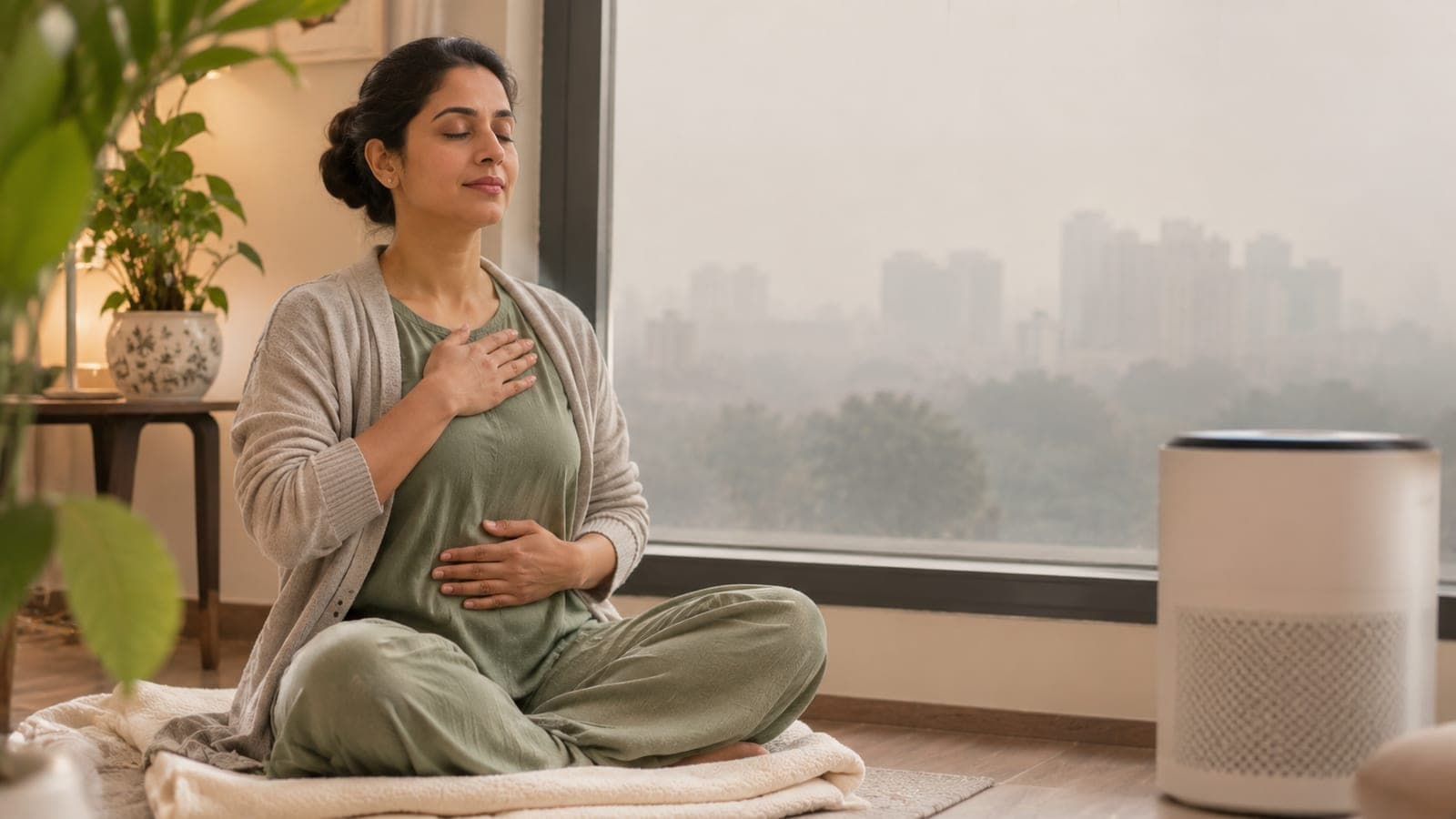
Breathwork cannot clean pollution out of your lungs, and vigorous pranayama outdoors on a high-AQI day increases the amount of particulate matter you inhale. What breathing practice can do is calm the stress response and improve breathing control. On 'Poor' or worse AQI days, practise gentle, slow nasal breathing indoors, windows closed, with an air purifier if you have one.
Every November someone sends me a video. A confident man in white, a hazy Delhi skyline behind him, explaining that five minutes of kapalbhati a day will "flush the smog out of your lungs".
I understand why it spreads. The air in much of north India is genuinely frightening at this time of year, and a free, ancient practice that undoes it would be wonderful news. Unfortunately it isn't true — and on the worst days, that particular advice does the opposite of what it promises.
We teach breathwork every single day at Ushmaya and I believe in it completely. Which is exactly why it's worth being precise about what it can and cannot do when the air is bad.
Why the air is worst in November
North Indian winters trap pollution. Cooler air near the ground and low wind speeds mean emissions from traffic, industry, construction dust, burning and — around this time — festival fireworks sit over the plains instead of dispersing. The result is the smog season that runs roughly from late October into January, with November often among the worst stretches.
The pollutant that matters most for health is PM2.5 — particles smaller than 2.5 micrometres, fine enough to travel deep into the lungs.
What India's AQI numbers mean
India's National Air Quality Index groups readings into six bands. They are worth knowing, because they should change what you do.
| AQI | Category | What to do with your practice |
|---|---|---|
| 0–50 | Good | Practise anywhere |
| 51–100 | Satisfactory | Practise anywhere; sensitive people take care |
| 101–200 | Moderately polluted | Keep outdoor sessions gentle and short |
| 201–300 | Poor | Move exercise and pranayama indoors |
| 301–400 | Very poor | Indoors only; limit time outside generally |
| 401–500 | Severe | Indoors, windows shut; follow official health advisories |
The uncomfortable fact about fast breathing
Your exposure to pollution depends on two things: how polluted the air is, and how much of it you breathe.
At rest you move somewhere around six to eight litres of air a minute. Run, or do a vigorous round of kapalbhati or bhastrika, and that figure climbs sharply. Every extra litre in polluted air is an extra dose of particles.
So the honest advice is the reverse of the video: on high-AQI days, the forceful practices are the ones to stop. Not because they are bad practices — on a clean morning by the river they are excellent — but because their entire mechanism is moving more air.
Can you "detox" your lungs?
No. The lungs do have a clearance system — a layer of mucus and millions of tiny hair-like cilia that move it upwards — and coughing and breathing normally support it. But there is no breathing technique, herb or drink that has been shown to pull fine particulate matter back out of lung tissue.
This matters, because believing in a detox makes people careless about exposure. "I'll do my breathing in the evening" is not a substitute for not running along the ring road at 7am.
So what does breathwork actually do in smog season?
Something real and useful: it works on the nervous system.
Slow breathing — around six breaths a minute, with a longer exhale than inhale — shifts the body towards parasympathetic activity, the rest-and-digest state. It lowers the sense of threat, and the ongoing low-level anxiety of living under a grey sky for weeks is a real thing. I explain the mechanism in the vagus nerve, explained.
It also builds breathing control, which helps if you find yourself breathing fast and shallow under stress — a pattern that, in polluted air, makes things worse rather than better.
A smog-season breathing routine (indoors, 12 minutes)
Do this in a room with the windows closed, ideally with an air purifier running.
- Settle (2 minutes). Sit upright, shoulders soft. Breathe through the nose without changing anything. Just notice.
- Slow breathing (5 minutes). Inhale through the nose for a count of four, exhale through the nose for a count of six. That works out at six breaths a minute. If six feels strained, use three and five.
- Gentle alternate-nostril breathing (3 minutes). Nadi shodhana, slowly, without breath retention. Smooth and quiet — if you can hear it, it's too forceful.
- Rest (2 minutes). Lie down or sit back. Let the breath go back to normal.
No kapalbhati, no bhastrika, no breath holds until the AQI is back under 200 — and longer breath retentions should be learned with a teacher in any case.
Keeping moving when you can't go outside
The other casualty of smog season is exercise. People who walk or run outdoors stop for weeks, and then wonder why they feel flat, stiff and sleep badly by December. Stopping outdoor exertion on bad days is right. Stopping movement altogether isn't.
A few things that work indoors:
- Yoga at a moderate pace. Slow sun salutations, standing poses and gentle twists keep the body moving without the heavy breathing of a run. Keep the room closed and, ideally, filtered.
- Short strength sessions. Squats, lunges, push-ups against a wall or a table, slow and controlled. Strength work raises breathing far less than cardio.
- Stairs, in a closed building. A few flights at an easy pace, several times a day.
- Walking indoors. A mall corridor or office floor early in the day is unglamorous and perfectly effective.
Save running, cycling and intense outdoor practice for clean-air days. They come — usually after rain or a change in the wind — and checking the AQI each morning lets you catch them.
What smog season does to the mind
There is a psychological cost to weeks under a grey sky that rarely gets discussed. People describe a low, constant unease: keeping children indoors, checking the numbers several times a day, a faint guilt every time they step outside. Sleep gets worse, tempers shorten.
This is where breathwork genuinely earns its place. It won't change what's in the air, but ten minutes of slow breathing twice a day gives the nervous system a regular signal that it is safe — which, in a season that feels like a low-grade emergency, is worth a great deal. If that unease is turning into persistent anxiety or low mood, speak to a doctor; it is a real response to a real situation, and it deserves real support.
Practical protection that matters more than any practice
- Check the AQI before going out, and move exercise indoors on Poor or worse days.
- Wear a well-fitted N95 or equivalent mask outdoors on bad days. A loose cloth mask does little for PM2.5.
- Use an air purifier in the room you sleep in, sized for that room.
- Keep windows closed during peak pollution, and ventilate when readings drop.
- Breathe through your nose. It won't stop PM2.5, but it filters larger particles and warms and humidifies the air.
- If you use jala neti, use only boiled-and-cooled, distilled or sterile water — never straight from the tap.
And if you have asthma, COPD, heart disease or are pregnant, your doctor's advice on pollution comes first. Breathlessness, chest pain or wheezing that doesn't settle is a medical matter, not a breathing-practice one.
The case for a few days of clean air
I won't pretend Rishikesh has a magic bubble over it — no hill town is entirely untouched in a bad winter, and you should check the readings like anywhere else. But a few days away from the dense urban plains, outdoors in moving air, with the breathwork done by a river rather than in a sealed bedroom, is restful in a way that's hard to explain until you've had it.
Our Digital Detox & Stress Recovery programme is built around exactly that kind of nervous-system work, and the 3-Day Hydro Retreat is the short version.
If you're living with the smog-season anxiety I described and want somewhere to breathe slowly for a few days, tell us what you need.
Key takeaways
- There is no such thing as a 'lung detox' you can breathe your way into. The only reliable protection from polluted air is breathing less of it.
- Fast, forceful practices — kapalbhati, bhastrika, running — move more air through your lungs per minute. In smog, that means more particles. Save them for clean-air days.
- Slow nasal breathing at around six breaths a minute is the practice to keep in smog season: indoors, gentle, and good for the nervous system.
- On India's National AQI scale, 'Poor' starts at 201. From there, move exercise and pranayama indoors; from 'Very Poor' (301+), limit time outside altogether.
- Jala neti uses only boiled-and-cooled or sterile water — never straight from the tap. Anyone with asthma, COPD or heart disease should follow their doctor's pollution advice first.
Frequently asked
Can pranayama clean my lungs of pollution?
No. The lungs clear particles through their own mechanisms — mucus and the tiny hair-like cilia that move it — and no breathing technique has been shown to remove fine particulate matter such as PM2.5 from lung tissue. Claims that kapalbhati or any other practice 'detoxes' the lungs are not supported.
Should I do yoga and breathing exercises outdoors when the AQI is high?
Not on Poor (201–300), Very Poor (301–400) or Severe (401+) days on India's AQI scale. Exertion and fast breathing increase the volume of air — and therefore pollution — you inhale. Practise indoors with windows closed, ideally in a room with an air purifier.
Which breathing exercises are safe on bad-air days?
Gentle, slow practices done indoors: slow nasal breathing at about six breaths a minute, extended exhalation (for example inhale for four, exhale for six), and calm alternate-nostril breathing without breath retention. Avoid forceful or rapid techniques until the air improves.
Does breathing through the nose filter pollution?
The nose filters larger particles reasonably well, which is one more reason to breathe nasally, but it does not stop fine particles like PM2.5. It is a help, not a shield. A well-fitted N95 or equivalent mask outdoors does far more.
Is jala neti useful in smog season?
Many people find saline nasal rinsing soothing when the air is dusty. Use only boiled-and-cooled, distilled or sterile water and a clean neti pot. Never use untreated tap water, and stop if it causes pain or nosebleeds.
Written by
Rajesh Chada
Founder & CMD, The Ushmaya
Rajesh is the founder of The Ushmaya and the reason Kneipp hydrotherapy exists in India. He writes about water cure, Ayurveda and what genuine healing asks of you.
About Rajesh→A note on medical advice. This article is written for general understanding and is not a diagnosis or a treatment plan. Hydrotherapy, Panchakarma and fasting protocols are powerful and are not appropriate for everyone — particularly during pregnancy, or with cardiac, renal, circulatory or acute conditions. Every therapy at Ushmaya is prescribed after a consultation with our resident physicians. Please speak to your own doctor before changing how you treat a diagnosed condition.