
Mind, Breath & Sleep
A 15-Minute Winter Morning Yoga Routine for Cold, Stiff Mornings

By Rajesh Chada · Founder & CMD, The Ushmaya
27 November 2026 · 6 min read
In short
A good winter morning yoga routine starts slowly with joint rotations, builds warmth with unhurried sun salutations and standing poses, then settles with a twist, a gentle backbend and slow breathing. Fifteen minutes is enough. Practise in a warm room on a mat or blanket, wear layers you can remove, and never force a cold, stiff body into deep stretches.
There is a moment on every winter morning when you're awake but still under the quilt, the room is cold, and your body feels like it has been assembled overnight from slightly rusty parts. The temptation is to stay there. The second temptation is to leap up and do something vigorous to get warm.
Neither is what a cold body needs. What it needs is fifteen unhurried minutes that start at the joints, build gentle heat, and finish with the breath.
Before you start
- Warm the room, or at least the corner you'll practise in. Cold air on a sweaty body afterwards is no friend.
- Use a mat or a folded blanket. A cold stone floor draws heat out of you quickly.
- Layer up. Socks and a light sweater to start; peel them off as you warm.
- Drink a glass of warm water first.
- Practise on an empty stomach, or an hour or two after eating.
The 15-minute routine
1. Joint warm-ups — sukshma vyayama (4 minutes)
Seated or standing, slowly, five to ten rounds each:
- Neck: gentle nods, then slow turns left and right. No full head circles.
- Shoulders: roll them back, then forward.
- Elbows and wrists: circle the wrists, open and close the hands.
- Hips: hands on hips, slow circles.
- Knees: feet together, hands on knees, small circles.
- Ankles: lift one foot, circle the ankle each way; switch.
This is sukshma vyayama, the subtle joint exercises traditionally taught before asana. It's the safest way into a cold body, and on stiff mornings it's worth doing even if you do nothing else.
2. Cat–cow (1 minute)
On hands and knees, inhale as you lift the chest and tailbone; exhale as you round the back. Slowly, following the breath. Eight to ten rounds.
3. Slow sun salutations — surya namaskar (5 minutes)
Four to six rounds, at the pace of your breath. In winter, slower is warmer: steady movement builds heat without leaving you breathless.
Bend your knees as much as you need in the forward folds. If a full round is too much, use a half version — stand, raise the arms, fold forward, half-lift, fold, come up.
4. Warming standing poses (2½ minutes)
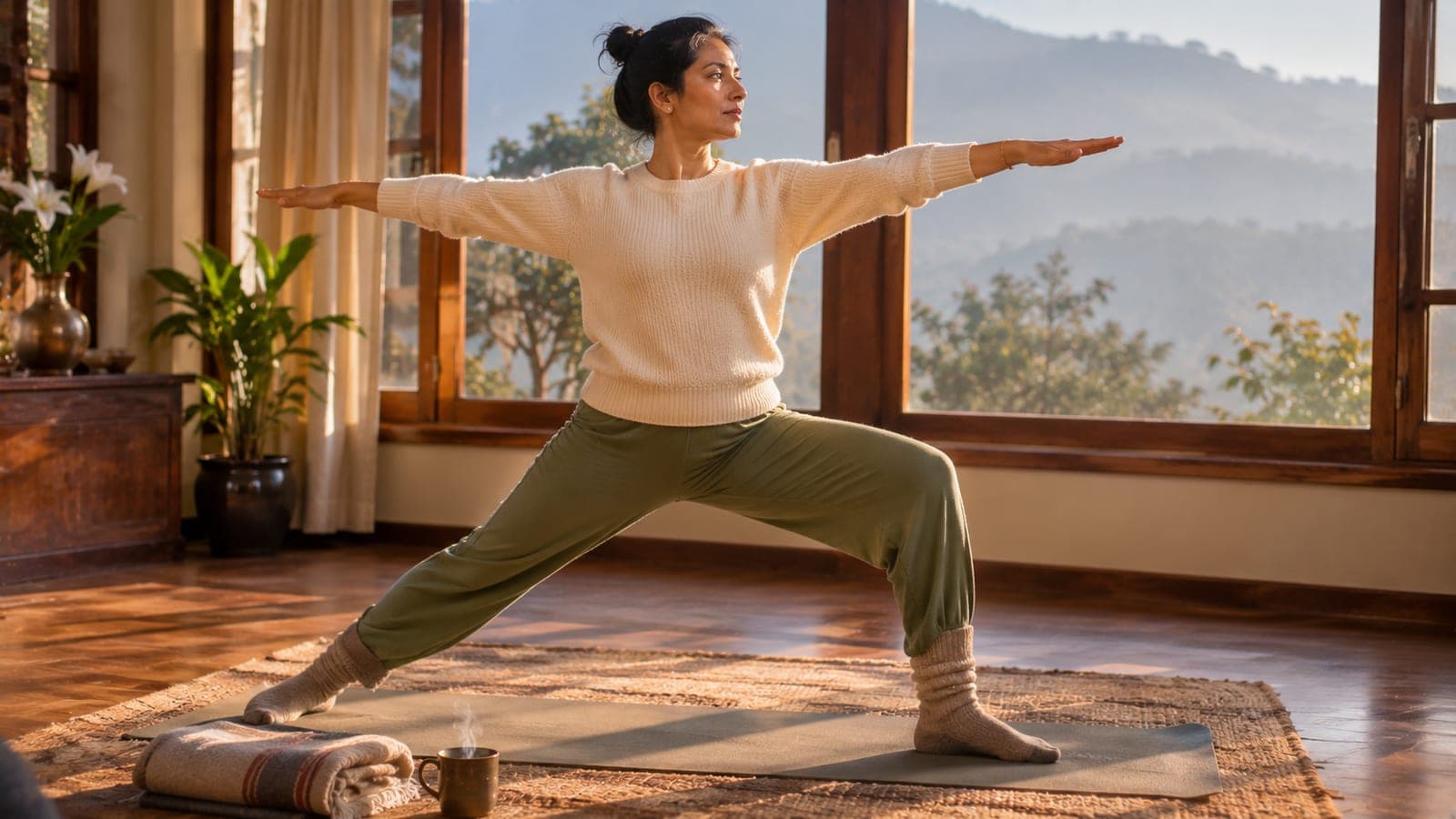
- Warrior II (Virabhadrasana II): 30 seconds each side. Feet wide, front knee bent over the ankle, arms extended. Breathe into the legs.
- Triangle (Trikonasana): 30 seconds each side. Long sides, no collapse; the hand rests on the shin, not the floor.
- Chair pose (Utkatasana): 20–30 seconds. Quietly generates a lot of heat.
5. Twist and gentle backbend (1½ minutes)
- Seated twist: sitting cross-legged, turn gently to each side for five breaths.
- Bridge (Setu Bandhasana): lying on your back, knees bent, lift the hips for five breaths; lower slowly. Twice.
6. Breath and stillness (1 minute or more)
Sit comfortably. Breathe in through the nose for four, out for six, for six to ten breaths. Then sit still for a few breaths, notice how different the body feels from fifteen minutes ago, and get up slowly.
Put your warm layer back on before you open the door.
The routine at a glance
| Part | Time | What it does |
|---|---|---|
| Joint warm-ups | 4 min | Lubricates joints safely in a cold body |
| Cat–cow | 1 min | Mobilises the spine with the breath |
| Slow sun salutations | 5 min | Builds steady, even warmth |
| Standing poses | 2½ min | Warms and strengthens legs and hips |
| Twist and bridge | 1½ min | Releases the spine and opens the front body |
| Breath and stillness | 1 min+ | Settles the nervous system for the day |
Making it work in winter
Go slower, not faster. Rushing a cold body into deep stretches is how winter strains happen. Stiffness is normal at the start; sharp pain is a signal to stop.
Follow it with warmth. A warm shower afterwards, or — if you want the full Ayurvedic winter morning — warm sesame oil massage before the shower. The two habits fit together beautifully.
Get some light. If you can, finish by stepping outside for a few minutes of morning sun. It does more for your body clock than any pose.
Keep the fast breathing for later. Vigorous practices like kapalbhati are warming, but they're best learned with a teacher, avoided if you have high blood pressure or heart disease, and not done outdoors on days when the air quality is poor.
A chair version for stiff or older bodies
If getting down to the floor is hard on a cold morning, the whole routine adapts to a sturdy chair without arms:
- Joint warm-ups work exactly as written, seated.
- Seated cat–cow: hands on knees, arch the chest forward on the inhale, round the back on the exhale.
- Chair sun salutation: arms up on the inhale, fold forward over the thighs on the exhale, hands to the shins; come back up slowly. Six rounds.
- Seated Warrior II: sit sideways on the chair, front knee bent over the ankle, back leg extended, arms out.
- Seated twist: turn to each side holding the back of the chair, five breaths each.
- Standing support: finish with a few slow sit-to-stands, holding a table if needed — one of the most useful strength exercises for later life.
Keep the breath slow throughout. It is the same practice, at a different height.
An evening version
Winter evenings are long, and a short practice before bed is a good use of ten of those minutes. Leave out the sun salutations and the heat-building poses, and keep:
- joint rotations, slowly (3 minutes)
- cat–cow (1 minute)
- a supported forward fold, seated, with a cushion under the knees (2 minutes)
- a gentle reclining twist on each side (2 minutes)
- legs up the wall, or simply lying with the knees bent (2 minutes)
Then a few minutes of slow breathing with a long exhale, and bed. The morning version wakes the body up; the evening version tells it the day is over.
Who should be careful
Check with your doctor or a qualified teacher first if you have:
- high blood pressure or heart disease
- a recent injury or surgery
- osteoporosis
- back, neck or disc problems
- a pregnancy
And if morning stiffness lasts more than about half an hour, or joints are hot, swollen or painful, see a doctor — that isn't ordinary winter stiffness. Our Chronic Pain Relief Program exists for exactly the stiffness that has stopped being seasonal.
Taking it further
Fifteen minutes a morning, every morning, will change how your winter feels. If you'd like to learn the practice properly — the poses, the breathing and the rest — the seven-night Yoga & Inner Awakening Retreat is built around classical yoga, alongside Ayurvedic therapies and sattvic food. For evenings, pair this routine with Yoga Nidra, and if stress is what keeps you stiff, the vagus nerve, explained is worth reading.
Or talk to us about a programme that includes daily guided yoga by the Ganges — one of the best places there is to learn a morning practice you'll actually keep.
Key takeaways
- Start at the joints, not the big stretches. Five minutes of sukshma vyayama — gentle joint rotations — is the safest way into a cold body.
- Build heat with slow, steady sun salutations rather than fast ones. Four to six rounds, matched to the breath.
- Standing poses like Warrior II and Triangle warm the legs and hips; a seated twist and a bridge loosen the spine.
- Finish with two minutes of slow breathing and a moment of stillness, then get dressed warmly before stepping outside.
- Practise on a mat or folded blanket in a warm room, layer up, and ease off anything that hurts. Stiffness is normal; sharp pain is a signal to stop.
Frequently asked
What is the best yoga to do on a cold morning?
A gentle, warming sequence: joint rotations to begin, slow sun salutations to build heat, standing poses such as Warrior II and Triangle for the legs and hips, a twist and a bridge for the spine, and slow breathing to finish. Avoid deep or forceful stretches until the body is warm.
Is it OK to do yoga first thing in the morning in winter?
Yes, and many people find it the best way to shake off morning stiffness. Practise in a warm room, wear layers, start slowly and build gradually. Drink a glass of warm water first, and if possible practise before breakfast or at least an hour or two after eating.
How long should a winter morning yoga practice be?
Fifteen minutes is enough to loosen the joints, warm the body and settle the mind. If you have more time, extend the sun salutations and standing poses, or add a few minutes of meditation at the end. Consistency matters more than length.
Can yoga help with stiffness in winter?
Gentle daily yoga helps many people feel less stiff, because joints and muscles loosen with movement and warmth. If stiffness lasts more than half an hour each morning, or joints are hot, swollen or painful, see a doctor, as this may be inflammatory arthritis.
Who should be careful with this routine?
If you have high blood pressure, heart disease, a recent injury or surgery, osteoporosis, back or neck problems, or are pregnant, check with your doctor or a qualified teacher first and modify the poses. Skip any movement that causes sharp pain.
Written by
Rajesh Chada
Founder & CMD, The Ushmaya
Rajesh is the founder of The Ushmaya and the reason Kneipp hydrotherapy exists in India. He writes about water cure, Ayurveda and what genuine healing asks of you.
About Rajesh→A note on medical advice. This article is written for general understanding and is not a diagnosis or a treatment plan. Hydrotherapy, Panchakarma and fasting protocols are powerful and are not appropriate for everyone — particularly during pregnancy, or with cardiac, renal, circulatory or acute conditions. Every therapy at Ushmaya is prescribed after a consultation with our resident physicians. Please speak to your own doctor before changing how you treat a diagnosed condition.