
Mind, Breath & Sleep
What Actually Happens in the First 72 Hours of a Digital Detox

By Rajesh Chada · Founder & CMD, The Ushmaya
26 September 2026 · 7 min read
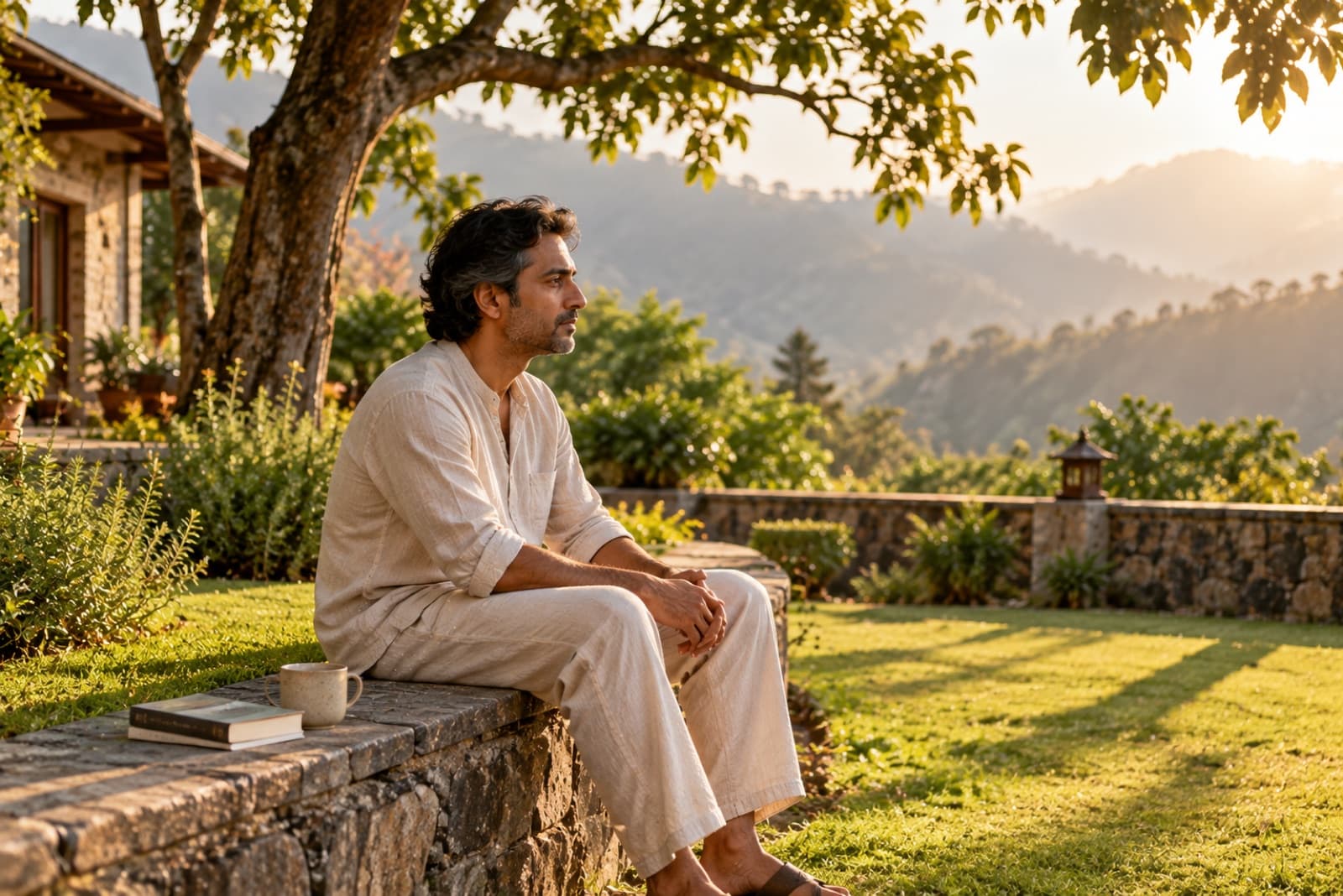
We don't confiscate phones. People find that disappointing, I think — they want the decision taken away from them.
Instead there's a locker, a conversation, and a request: leave it there for three days and see what happens. Around eight in ten guests do. What follows is what they describe, and it is consistent enough that we now brief people on it in advance, because knowing the shape of it makes it survivable.
Hours 0–12: the phantom limb
The reaching starts almost immediately.
Guests describe patting a pocket that is empty, forty or fifty times on the first afternoon. The hand goes before the thought does. There is a specific flinch when you sit down to a meal and there is nothing to hold.
What is actually happening is unremarkable. You have a deeply conditioned behavioural loop — a moment of low stimulation, a reach, a small variable reward. Remove the reward and the reach continues for a while on its own, like a phone vibrating in a drawer.
The accompanying feeling is anxiety, and it is usually quite specific: something is happening and I don't know about it. Not boredom yet. Vigilance. People ask, repeatedly and apologetically, whether anyone has called.
What helps: a schedule. We fill the first afternoon deliberately — a therapy, a walk, an orientation, dinner at seven. Unstructured time on day one is where people break and go to the locker.
Hours 12–36: the crash
Day two is the worst day of any retreat, and it is worse again on a digital detox. I want to be blunt about this because people assume something has gone wrong.
What arrives, usually all at once: a headache. Heavy, dragging fatigue — the kind where walking to breakfast feels like an imposition. Irritability, often directed at something trivial. A low, flat mood. Occasionally nausea. And a strong, articulate conviction that this was a mistake.
Why. Four things land simultaneously:
- Caffeine withdrawal. Peaks at 20–48 hours. This is most of the headache, and the reason we remove coffee is set out in what's on the plate.
- The parasympathetic rebound. A nervous system that has run on sympathetic activation for years, finally allowed to stand down, does not feel pleasant about it. It feels like being unplugged. This is the physiology in the vagus nerve and burnout.
- Dopamine recalibration. Your baseline has been set by a device engineered to deliver variable reward. Remove it and ordinary life is briefly, measurably, not enough. Everything feels beige.
- Sleep debt arriving. Given permission, the body collects. People sleep ten and eleven hours and wake unrefreshed, which is alarming and entirely normal.
What helps: knowing it is day two. Nothing else, really. We lighten the therapy load, keep guests warm, feed them khichdi and send them to bed early. It passes inside twelve hours in almost everyone.
Hours 36–60: the boredom
Day two evening into day three is where the genuinely interesting thing happens, and it isn't pleasant either. It's boredom — but a specific kind that most adults have not experienced in fifteen years.
Not I have nothing to do. Guests have plenty to do. It is I have a gap of eleven minutes and no idea what to put in it.
Watch anyone in that state and you see them try several things in sequence: staring, fidgeting, striking up a slightly forced conversation, examining a plant with unusual attention, going to look at the river again. This is the thing that fifteen years of filled micro-gaps has removed — the capacity to be unstimulated without distress.
And it is also the point of the exercise. Boredom is not a problem to solve; it is the precondition for several things that cannot happen without it. Mind-wandering. The default mode network. The specific mental state in which unprompted ideas arrive and unprocessed feelings surface.
People get unexpectedly emotional on day two and three, and they apologise for it. They shouldn't. A nervous system that has been using stimulation as a lid, with the lid removed, is going to do exactly this. It is usually the most useful twelve hours of the week.
What helps: permission. Being told in advance that empty time is the treatment rather than a scheduling failure changes how people experience it entirely.
Hours 60–72: the turn
It arrives, in most people, somewhere in the afternoon of day three. It is undramatic and unmistakable.
Guests describe it in oddly similar terms. I was watching the water and I realised I'd been watching it for twenty minutes. I read forty pages without checking anything. I can hear more.
What is actually recovering is sustained attention — the capacity to hold one thing for an extended period without the pull toward switching. Nothing mystical has occurred. The constant demand for attentional switching has been removed for long enough that the system has stopped bracing for it.
Three other things typically show up with it:
- Sleep consolidates. The 3am waking stops. Dreams return, often vividly.
- Food tastes different. Not better food — the same food, with attention on it.
- Conversation lengthens. Dinner at a table where nobody has a phone runs to ninety minutes without anyone deciding it should.
This is the state we are trying to reach, and it is the single strongest argument against a two-night stay: if you book two nights, day two is your last day, and you go home having experienced only the withdrawal. The arithmetic behind each duration is in how long a retreat should be.
What we replace it with
A detox that only subtracts is just an absence. The schedule matters more than the locker.
In practice, our Digital Detox & Stress Recovery programme replaces screen time with four specific things:
Rhythm. Up at 5.30, therapy, breakfast, rest, lunch, therapy, walk, dinner at seven, bed by nine-thirty. Imposed from outside, which is the only reason it works.
Physical down-regulation. Shirodhara, hydrotherapy and breathwork, scheduled in the morning when the pull toward the phone is strongest. Cold water in particular does in sixty seconds what an hour of trying to relax cannot — see contrast bath therapy.
A practice to be bored into. Yoga Nidra daily. It is the ideal detox practice precisely because it asks nothing of you but stillness: no concentration to sustain, nothing to be good at. The mechanism is here.
Nature, unaccompanied. Walks by the river without a camera. The Ganga Aarti in the evening. Sitting outside after dark, which the classical Sharad regimen prescribes as sitting in moonlight and which is, functionally, a screen-free hour outdoors in cool air.
Going home without losing it
This is the hard part, and I will not pretend we have solved it. What demonstrably helps:
- Keep the phone out of the bedroom. The single highest-yield change. Buy a clock.
- Protect the first and last hour of the day. No screen before the first meal, none after dinner.
- Leave the micro-gaps empty. The queue, the lift, the four minutes before a meeting. Deliberately do nothing. This is the capacity you rebuilt; it decays fastest.
- Keep one practice, daily, non-negotiable. Twenty minutes of Nidra, or five minutes of extended exhale. Something, every day, rather than everything twice a week.
- Put one longer gap in the calendar. A day a month without a device, booked before you need it.
The honest expectation: you will lose a good portion of it within three weeks. You will not lose all of it, and what remains is mostly the knowledge that the other state exists and is reachable. That turns out to matter more than the retreat itself, because you stop accepting the wired-and-exhausted baseline as simply how adult life feels.
If you are weighing this up
Two things to know before you book.
The first is that it is harder than it sounds and easier than you fear. Day two is genuinely unpleasant. Day three is why people come back.
The second is that it only works with a structure. A week in a hotel with your phone in a drawer and no schedule will not produce this; you will last a day and a half. What produces it is somebody else owning the timetable while your nervous system does something it has not been allowed to do for years.
Three days is the minimum honest ask. A week is where it settles. And if you want to know whether now is the right moment, talk to us — bring the phone to the call.
Written by
Rajesh Chada
Founder & CMD, The Ushmaya
Rajesh is the founder of The Ushmaya and the reason Kneipp hydrotherapy exists in India. He writes about water cure, Ayurveda and what genuine healing asks of you.
About Rajesh→A note on medical advice. This article is written for general understanding and is not a diagnosis or a treatment plan. Hydrotherapy, Panchakarma and fasting protocols are powerful and are not appropriate for everyone — particularly during pregnancy, or with cardiac, renal, circulatory or acute conditions. Every therapy at Ushmaya is prescribed after a consultation with our resident physicians. Please speak to your own doctor before changing how you treat a diagnosed condition.