
Mind, Breath & Sleep
Yoga Nidra: The 30-Minute Practice That Does More Than a Nap

By Rajesh Chada · Founder & CMD, The Ushmaya
16 September 2026 · 6 min read
The most common complaint we hear is not pain, weight or digestion. It is sleep.
Specifically, two versions of it. I can't fall asleep — a mind that won't stop at 11pm. And I wake at 3am — asleep in minutes, awake four hours later, hot, alert, and running through tomorrow.
Both are nervous-system problems rather than sleep problems, and both respond to the same thing. Of everything in our programmes, the practice that produces the fastest change in sleep is the one that asks the least of you.
What Yoga Nidra actually is
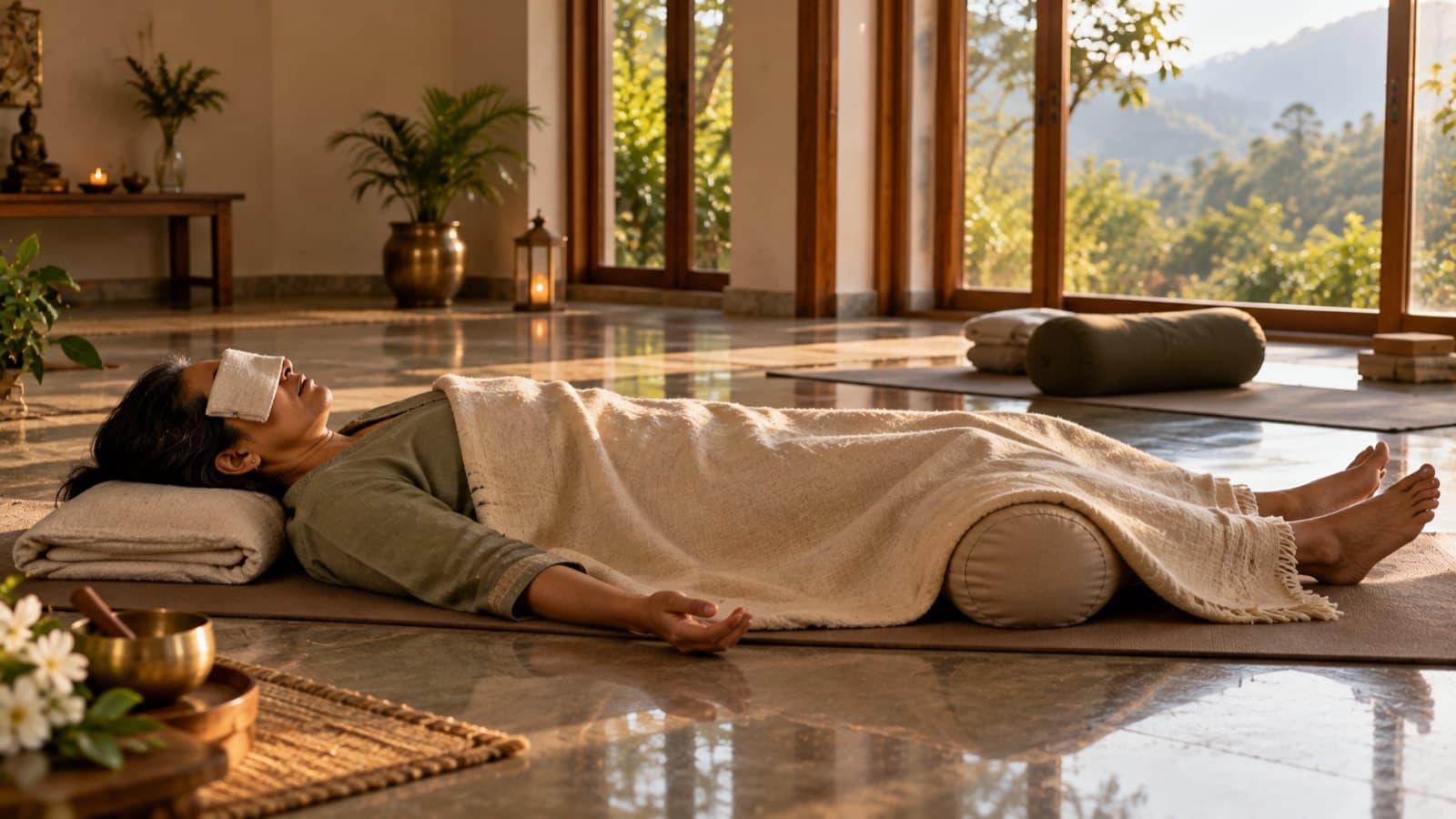
Yoga Nidra means yogic sleep, which is slightly misleading. You are not asleep. You are lying still, usually in supported savasana, following a voice through a precise sequence while remaining — just — awake.
It is not meditation in the usual sense. There is no concentration to sustain, no breath to count, no posture to hold, nothing to get right. This is why it works for people who have decided they cannot meditate: there is no skill being tested.
The traditional structure, as systematised by Swami Satyananda from older tantric practice, has a consistent arc:
- Settling — physical stillness, an initial scan, letting the body become heavy.
- Sankalpa — a short resolve, stated once, in the present tense.
- Rotation of consciousness — attention moved rapidly through named body parts in a set order. This is the engine of the practice.
- Breath awareness — observing, usually counting backwards.
- Opposites — heaviness and lightness, heat and cold, held in awareness in turn.
- Visualisation — imagery, archetypal or natural.
- Sankalpa again, then a slow return.
Forty minutes in the classical form; twenty to thirty is plenty.
Why it works
Three mechanisms, and they stack.
The rotation hits a map in your brain. The sequence of body parts is not arbitrary — it follows the somatosensory cortex, the homunculus, in order. Thumb, each finger, palm, wrist, forearm. Moving attention rapidly along that map while the body stays perfectly still produces a distinctive thing: sensory withdrawal, pratyahara. Input drops away and the cortex quietens.
You enter a state that is neither waking nor sleeping. EEG studies of experienced practitioners show a shift from alpha to theta-dominant activity, with pockets of delta — the signature of deep sleep — while awareness is retained. It is the hypnagogic state at the edge of sleep, normally passed through in seconds, held deliberately for half an hour. That is why thirty minutes feels like two hours: in terms of brain activity, something closer to two hours of restorative sleep has occurred.
Parasympathetic activity rises, sharply. Heart rate falls, variability increases, cortisol drops, breathing lengthens unbidden. Unlike many meditation practices, Yoga Nidra requires no effort to produce this — which matters, because effort is sympathetic. A person in burnout trying hard to meditate is often making things marginally worse. I've written about why the direction of that lever matters in the vagus nerve and burnout.
What it is good for
In our experience, in order of reliability:
- Insomnia and broken sleep. The strongest and fastest effect. Often a change within three or four sessions.
- The 3am waking. This is usually a cortisol-and-heat pattern rather than true insomnia, and it is extremely common in September when pitta is aggravated. Nidra in the late afternoon, rather than at bedtime, tends to work better for it — see the Sharad Ritu guide for the seasonal reasoning.
- Burnout and chronic fatigue. Rest without the demand that you perform resting.
- Anxiety. Reliably, though gently, and best alongside other work.
- Chronic pain. Changes the relationship to pain more than the pain itself, which in long-standing pain is often the more useful target. It is part of our chronic pain programme for exactly this reason.
- Recovery after therapy. We schedule it after hydrotherapy and oil treatments, because it is when the body consolidates what the therapy started.
What it is not: a treatment for a diagnosed sleep disorder. If you snore heavily, stop breathing in your sleep, wake unrefreshed after eight hours, or your partner has noticed gaps, get assessed for sleep apnoea. No amount of Nidra fixes an obstructed airway.
How to do it tonight
Honestly, properly, no equipment.
The setup. Lie on your back on a firm surface, not a soft bed. A thin pillow under the head, a rolled blanket under the knees to flatten the lower back, something covering you — your temperature will drop. Arms a little away from the body, palms up. An eye pillow or folded cloth over the eyes makes a surprising difference.
The rule. Do not move. This is the only discipline in the whole practice. Scratching an itch breaks the sensory withdrawal and you start again. Get comfortable first, then commit to stillness.
The guidance. You need a voice, at least at the start. Self-guiding defeats the purpose — the mind cannot both produce the instruction and let go. Any good recorded Satyananda-tradition Nidra will do.
The timing. Late afternoon (4–6pm) is the classical slot and the best one for a genuine restorative effect. Right before bed is fine if you only want to fall asleep. Not within ninety minutes of a heavy meal.
If you fall asleep. You will, for the first few weeks. That's fine and it is not failure — it means you were short of sleep. The practice deepens as the debt clears.
Nidra, meditation or a nap?
A quick comparison, because people use these interchangeably.
| What it asks | What it gives | |
|---|---|---|
| Nap | Nothing | Sleep, plus sleep inertia — that groggy twenty minutes after. Can disturb night sleep. |
| Meditation | Sustained attention | Trained attention, emotional regulation. Requires effort; can frustrate the exhausted. |
| Yoga Nidra | Stillness only | Deep physiological rest with awareness retained. No grogginess. No skill required. |
A nap is passive. Meditation is active. Nidra is the odd one out — receptive. It is the only one of the three that reliably helps someone too tired to concentrate and too wired to sleep, which is precisely the state most people arrive here in.
Why it works better here
Two reasons, neither of them mystical.
First, Nidra works best when the body is already starting to let go, which is why we never schedule it cold. It follows hydrotherapy, or oil therapy, or a slow evening practice. By the time you lie down, the body has been given a physical reason to down-regulate and the Nidra deepens what is already underway. That sequencing is the whole argument for a programme over a playlist — and it is why it appears daily rather than occasionally in the Digital Detox & Stress Recovery programme and in the Sacred Silence Meditation Retreat.
Second, three or four consecutive days. Almost everyone falls asleep in the first two sessions. The real state — the one worth the time — generally arrives on day three, and almost nobody gets to day three at home.
Tonight
Twenty minutes. Firm surface, blanket over you, knees supported, eyes covered. A recorded Nidra. Do not move.
Then watch, over a fortnight, the one number that tells the truth: not how calm you felt, but how long it takes you to fall asleep at night, and whether you still wake at three.
If those don't move, the issue is upstream of the practice — heat, cortisol, diet, timing, or something that needs diagnosing. That's a conversation with a physician. Have it with ours.
Written by
Rajesh Chada
Founder & CMD, The Ushmaya
Rajesh is the founder of The Ushmaya and the reason Kneipp hydrotherapy exists in India. He writes about water cure, Ayurveda and what genuine healing asks of you.
About Rajesh→A note on medical advice. This article is written for general understanding and is not a diagnosis or a treatment plan. Hydrotherapy, Panchakarma and fasting protocols are powerful and are not appropriate for everyone — particularly during pregnancy, or with cardiac, renal, circulatory or acute conditions. Every therapy at Ushmaya is prescribed after a consultation with our resident physicians. Please speak to your own doctor before changing how you treat a diagnosed condition.