
Planning Your Retreat
Wellness Retreat vs Spa Holiday: Why the Difference Matters

By Rajesh Chada · Founder & CMD, The Ushmaya
29 September 2026 · 7 min read
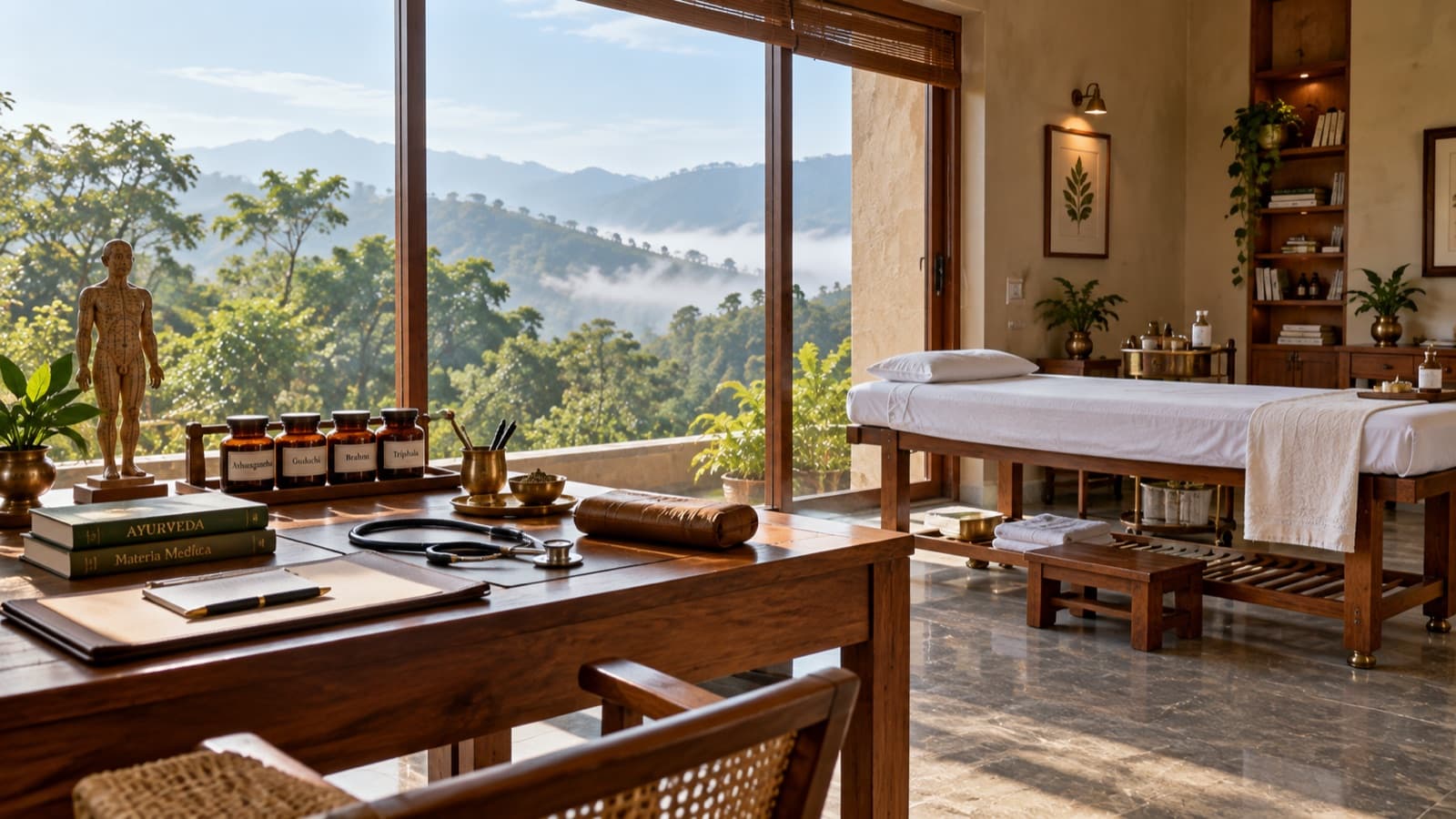
A woman called us in March, deeply unhappy, having just spent a great deal of money at a beautiful property three hours from here. Lovely room. Excellent massages. River view. She had gone to do something about chronic back pain and come home with the same back pain and a smaller bank balance.
Nobody had misled her. She had booked a spa holiday and expected a medical programme, and the website for both uses the same twelve words.
So here is the distinction, stated as plainly as I can manage.
The one question that separates them
Who decides what happens to you?
At a spa, you decide. There is a menu. You choose a 60-minute Swedish or a 90-minute Balinese, at 3pm on Tuesday, because that suits your day. The spa's job is to deliver what you ordered, beautifully.
At a wellness retreat, a clinician decides. There is a consultation, an assessment, and then a schedule you are handed rather than one you build. You may well not want Thursday's therapy. The retreat's job is to treat what it found, whether or not it is what you came in asking for.
Everything else — the food, the timings, the alcohol, the coffee, the price structure — follows from that one difference.
The honest comparison
| Spa holiday | Wellness retreat | |
|---|---|---|
| Your schedule | You build it | A physician prescribes it |
| Therapy selection | From a menu | From an assessment |
| Assessment | A form about allergies | A clinical consultation |
| Food | Hospitality — a buffet, a menu | Treatment — built for your constitution |
| Coffee, alcohol | Available | Generally removed, deliberately |
| Wake-up | When you like | 5.30–6am |
| Therapies connected? | Independent sessions | Sequenced, each building on the last |
| Length that makes sense | Any | Minimum three nights, ideally seven |
| What you leave with | A good rest | A protocol, a diet plan, a home practice |
| Aftercare | A feedback form | Follow-up and a plan |
| Measures success by | How you felt | What changed |
Neither column is better. They are answers to different questions.
Three things a retreat does that a spa structurally cannot
1. Sequence. This is the big one, and it is invisible from a brochure.
Every real programme moves through phases in order: down-regulate the nervous system, clear accumulated load, rebuild, then integrate. Each phase is a precondition for the next. A body in fight-or-flight doesn't absorb nutrients or respond well to deep tissue work, which is why day one is gentle and day five is not. Oil therapy on a system full of undigested residue drives the residue deeper — which is why pachana precedes snehana in Panchakarma, always.
A spa cannot sequence, because you are choosing. Four excellent treatments in the wrong order are four treatments. The same four in the right order are a programme.
2. Refusal. A retreat will tell you no.
If you ask for deep tissue work on an acutely inflamed joint, or cold immersion with uncontrolled hypertension, or a fourteen-day detox when what you actually need is to sleep for a week, the answer is no — with a reason. A spa's commercial logic makes that very hard; you have paid for a service and declining it is a bad guest experience.
That ability to refuse is, honestly, most of what you are buying. The contraindications for cold water alone are a long list, as set out in cold plunge vs Kneipp hydrotherapy.
3. Removal. A retreat takes things away.
Coffee, alcohol, chilli, late dinners, your phone, your lie-in. None of that is deprivation theatre — each removal is doing specific work, and the combination is what produces the week-one sleep change. A spa holiday adds pleasant things to a life that is otherwise unchanged. A retreat temporarily removes the things maintaining the problem, which is less fun and considerably more effective. What that first 72 hours feels like is in the digital detox piece.
Where the money actually goes
The thing that misleads people most is the nightly rate, because the two products price completely differently.
A spa holiday prices the room, then sells therapies on top. A ₹9,000 room plus three ₹6,000 treatments is ₹27,000 for the day, and nobody sequenced anything.
A retreat prices the programme. Our 3-Day Hydro Retreat at ₹12,599 and 7-Day Deep Healing Retreat at ₹35,999 both include every therapy, every meal, consultations and the protocol you leave with — which works out around ₹5,000–6,000 a night all in.
So the useful question is never what is the nightly rate. It is what fraction of this is treatment, and who decided on it?
Which one you actually need
Be honest with yourself about this, because the right answer is often the spa.
Choose a spa holiday if: you are basically well and tired; you want rest, good food and a nice room; you are travelling with someone whose priorities differ from yours; you want to choose your own days; you have four nights and want to enjoy all four. There is nothing second-rate about this. Rest is genuinely restorative and a good spa delivers it better than we do — our 5.30am bell is not a holiday.
Choose a wellness retreat if: you have a specific complaint rather than general tiredness; something has been going on for years rather than weeks; you are on medication you would like to need less of; you have tried the self-directed version and it didn't hold; or you want somebody else to take charge of your health for a week.
And a middle option worth knowing about: several of our curated packages sit deliberately between the two — structured, but gentler, shorter and designed for couples or for a first visit. The Sacred Ganga Getaway and The Couple's Bliss exist because not everyone arriving in Rishikesh needs a clinical programme, and pretending otherwise would be dishonest.
Six questions to ask before you pay
Send these to any property. The answers settle the question in a single email.
- Who designs my schedule, and what is their medical qualification? A name and a degree, or it's a spa.
- Is there a consultation before my therapies are decided? Before, not after.
- Can I choose my own treatments? If yes — spa. Useful to know, not a failing.
- Is food part of the treatment or part of the hospitality? A buffet is hospitality.
- What do I take home? A protocol and a diet sheet, or a goodbye?
- Who do I speak to in a month? The month after is when most gains are kept or lost.
A property that answers all six crisply is a real programme, whoever runs it. A property that answers in adjectives is selling a room.
The longer version of this — including the five distinct kinds of place operating in Rishikesh and what each is for — is in our complete guide to planning a retreat here.
The last word
The woman with the back pain came here in May for seven nights. She was not thrilled about the 5.30am start and said so, repeatedly, for two days. She left with a protocol, a set of corrective exercises, a diet she has mostly kept, and — at the last check — considerably less pain.
She also told me, accurately, that it had been much less relaxing than the spa.
Both things are true. That is the trade, and it is worth knowing which one you are buying before you buy it. If you tell us honestly what you're dealing with, we'll tell you which of the two you need — including when the answer is a nice hotel and a long sleep. Have that conversation first.
Written by
Rajesh Chada
Founder & CMD, The Ushmaya
Rajesh is the founder of The Ushmaya and the reason Kneipp hydrotherapy exists in India. He writes about water cure, Ayurveda and what genuine healing asks of you.
About Rajesh→A note on medical advice. This article is written for general understanding and is not a diagnosis or a treatment plan. Hydrotherapy, Panchakarma and fasting protocols are powerful and are not appropriate for everyone — particularly during pregnancy, or with cardiac, renal, circulatory or acute conditions. Every therapy at Ushmaya is prescribed after a consultation with our resident physicians. Please speak to your own doctor before changing how you treat a diagnosed condition.