
Ayurveda & Seasonal Living
Abhyanga: How to Do the Ayurvedic Oil Massage Winter Was Made For

By Rajesh Chada · Founder & CMD, The Ushmaya
14 November 2026 · 7 min read
In short
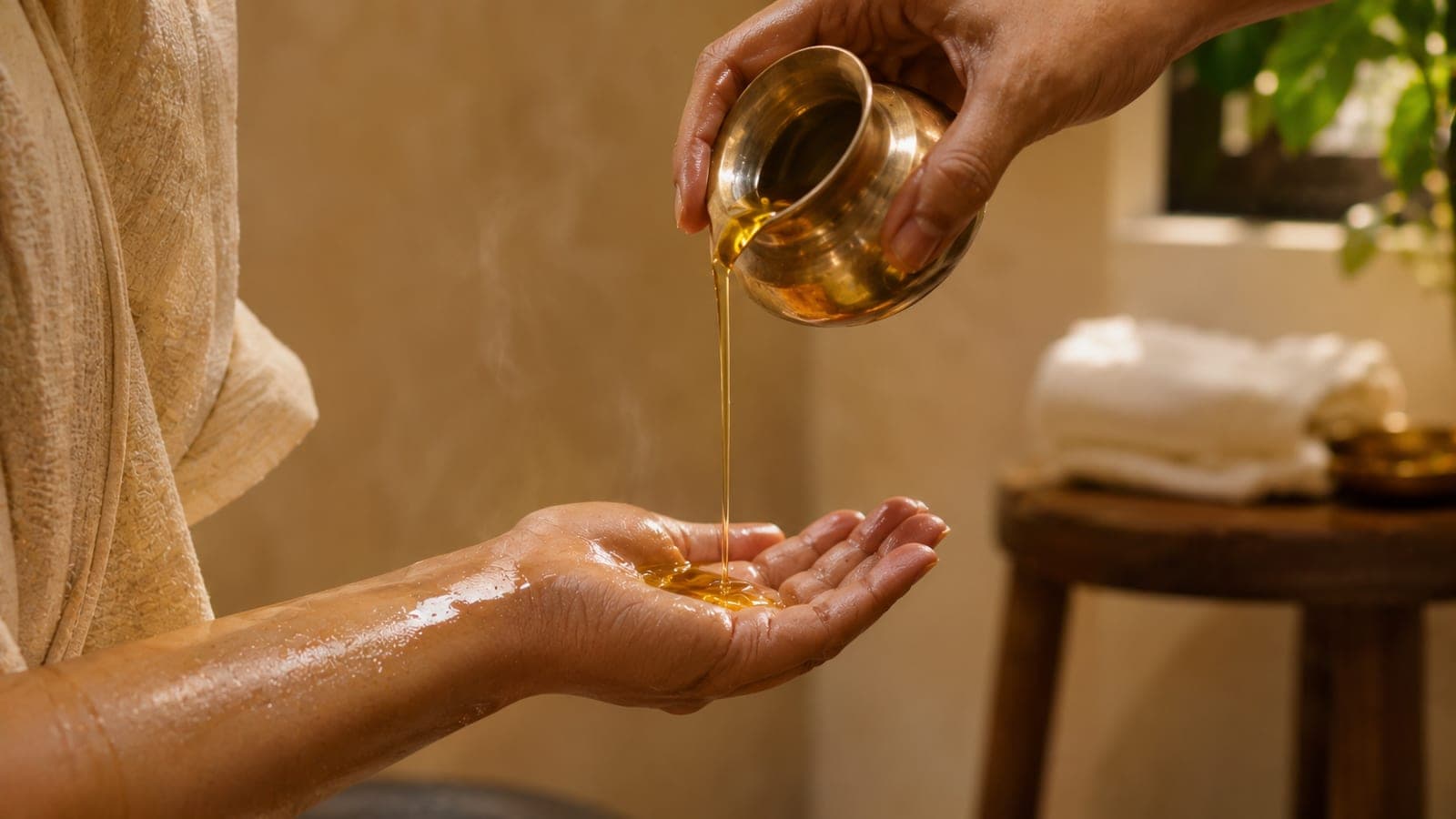
Abhyanga is Ayurveda's warm-oil self-massage, traditionally done daily before a bath. In winter, warm sesame oil is the classical choice because cold, dry weather aggravates vata. Massage the whole body for about ten minutes — long strokes on limbs, circles on joints, extra time on scalp, ears and feet — leave it fifteen minutes, then wash off with warm water.
If you could persuade me to keep only one Ayurvedic habit through a north Indian winter, it would not be a herb, a diet or a cleanse. It would be ten minutes with a bottle of warm sesame oil before my morning shower.
Abhyanga is the oldest, simplest, cheapest and most consistently appreciated thing we teach guests to take home. Here is how to do it properly.
What is abhyanga?
Abhyanga is the Ayurvedic practice of massaging the whole body with warm oil, traditionally every morning before bathing. It belongs to dinacharya — the daily routine — and the classical texts treat it as an ordinary daily habit for a healthy person, in the same breath as cleaning your teeth.
It also has a clinical life. In Panchakarma, external oleation is part of snehana, the preparation phase, which you can read about in our glossary entry on snehana and in what really happens during Panchakarma.
Why winter, especially?
Ayurveda describes cold, dry, windy weather as aggravating vata — the principle of movement and dryness. In practice that shows up as dry and itchy skin, stiff joints on cold mornings, cracked heels, light sleep and a restless, scattered mind.
Oil is the direct opposite of vata: warm where vata is cold, heavy where it's light, smooth where it's rough. That is the whole logic, and it's why winter is the season the practice was practically designed for.
Which oil should you use?
| Oil | Quality | Best for |
|---|---|---|
| Sesame (til), cold-pressed | Warming, grounding | The classical winter oil; most people, most of the winter |
| Coconut | Cooling | Summer, or people who run hot or have sensitive, reactive skin |
| Mustard (sarson) | Strongly heating, pungent | A north Indian winter tradition; too sharp for some skin types |
| Almond | Nourishing, mild | A gentle alternative, especially for the face |
| Medicated oils (Bala, Mahanarayan, Ksheerabala taila) | Therapeutic | Joint and muscle complaints, ideally on a practitioner's advice |
For most people, plain cold-pressed sesame oil — not toasted cooking sesame oil — is the right place to start. Patch-test any new oil on the inner arm first.
How to do abhyanga in ten minutes
Warm the oil. Stand the bottle in a bowl of hot water for a few minutes. It should feel pleasantly warm on the inside of your wrist, never hot.
Warm the room. Do this in a warm bathroom. Cold air on oiled skin defeats the purpose.
Then work from the top down:
- Scalp (2 minutes). A little oil into the crown, then firm circular movements with the fingertips across the whole scalp.
- Face and ears (1 minute). Gentle upward strokes on the face; a drop of oil rubbed around the outer ears and earlobes.
- Neck and shoulders (1 minute). Long strokes down the back of the neck and across the shoulders.
- Arms (1 minute). Long strokes along the long bones; circular strokes around the shoulders, elbows and wrists.
- Chest and belly (1 minute). Broad, gentle circles on the chest; clockwise circles on the belly, following the direction of digestion.
- Back (1 minute). As much as you can reach; up and down the lower back.
- Legs (1 minute). Long strokes on the thighs and shins; circles around the hips, knees and ankles.
- Feet (2 minutes). Take your time. Soles, heels, between the toes. If you only have time for one area, make it the feet.
Rest. Leave the oil on for ten to fifteen minutes. Put on an old robe, do some stretching, make tea.
Bathe. A warm shower or bucket bath. Use a mild soap only where you need it, or the traditional way: a paste of besan (gram flour) to lift the excess oil.
The two-minute version
On days when ten minutes is impossible, oil the scalp and the soles of your feet and leave it at that. Ayurveda gives particular importance to the head and feet, and in my experience, oiling the feet at night — padabhyanga — does more for winter sleep than almost anything else.
Abhyanga for common winter complaints
The basic method suits most people. A few adjustments make it more useful for specific winter troubles.
Dry, itchy skin. Oil before the bath rather than after, use warm rather than hot water, and go easy on soap — use it only where you need it. Pat dry rather than rubbing. Most people notice a difference within a week.
Cracked heels. Spend an extra two minutes on the heels at night with sesame oil or ghee, then put on cotton socks. Ayurveda considers this one of the classic uses of padabhyanga, and it is one of the quickest to show results.
Stiff joints on cold mornings. Warm the oil slightly more, use circular strokes over the joints, and follow with gentle movement before the shower. If stiffness is significant, a physician may suggest a medicated oil rather than plain sesame.
Light or broken sleep. Do the scalp and feet in the evening rather than the whole body in the morning. Oil on the soles at bedtime is the gentlest sleep ritual I know.
Cold hands and feet. Oil the hands and feet, then finish your shower with a brief splash of cold water on the feet and walk until they are warm — a small meeting point of Ayurveda and Kneipp.
For older family members, and children
Oil massage is deeply familiar in Indian homes: grandparents oiling their knees in the winter sun, babies massaged before their bath. Both traditions are worth keeping, with care.
For older people, use comfortably warm oil, a warm, draught-free room, and — above all — a safe bathroom: a non-slip mat, a stool, a rail to hold. A seated foot and knee massage in the sun is often more practical than a full-body routine.
For babies and young children, follow your paediatrician's advice on which oil to use, keep the oil only lukewarm, avoid the face, and never leave a child unattended on an oiled surface.
When not to do it
Abhyanga is gentle, but there are times to skip it:
- During a fever or any acute illness
- With a heavy cold or chest congestion, when the body is already holding excess kapha
- When digestion is off — indigestion, no appetite, a thick coating on the tongue
- Straight after a meal — wait at least an hour
- On broken, infected, inflamed or freshly sunburned skin
- During certain phases of Panchakarma, unless your physician directs it
If you have a skin condition, are pregnant, or have a medical condition you are unsure about, ask a practitioner first.
And one practical warning: oily feet and a wet bathroom floor are a genuinely bad combination. Put down a towel or a mat, and hold the wall.
How is it different from a spa massage?
A spa massage is done to you, as an occasional treat, for relaxation. Abhyanga, as Ayurveda means it, is done by you, daily, as maintenance — less a treatment than a way of looking after the body before it complains.
When it is done by therapists in a clinical setting, it also becomes something else: oils chosen for your constitution and condition, synchronised strokes from two therapists, and a sequence that builds over days alongside the rest of a programme. The difference between that and a spa massage is the difference I describe in wellness retreat vs spa holiday.
Learning it properly
Most people who learn abhyanga at a retreat keep doing it at home — it's one of the few habits that reliably survives the journey back. It is part of most programmes at Ushmaya, including the 7-Day Deep Healing Retreat, and the Golden Rest package pairs a full-body abhyanga with shirodhara for anyone whose winter complaint is mostly in the mind.
If you have joint pain, a skin condition or another reason to want the right oil rather than any oil, ask our physicians. Choosing the oil is where the practice becomes medicine.
Key takeaways
- Abhyanga is described in the classical texts as a daily practice, not an occasional treat. Charaka lists it among the habits of a healthy day.
- In winter use warm sesame oil. Coconut oil is cooling and suits summer; mustard oil, popular in north Indian winters, is very heating and suits some people better than others.
- Long strokes along the limbs, circular strokes over joints, and most attention to the scalp, ears and soles of the feet.
- Skip it when you have a fever, a cold with heavy congestion, indigestion or a coated tongue, straight after a meal, or on broken or inflamed skin.
- Leave the oil on for ten to fifteen minutes, then bathe in warm water. Be careful — oily feet on a wet bathroom floor are the one genuine hazard of the practice.
Frequently asked
What is abhyanga?
Abhyanga is the Ayurvedic practice of massaging the whole body with warm oil, usually in the morning before bathing. It is one of the daily routines (dinacharya) recommended in the classical texts, and also forms part of the preparation phase (snehana) of Panchakarma.
What are the benefits of abhyanga?
Traditionally it is said to nourish the skin, calm vata, ease stiffness, support sleep and steady the mind. In practical terms most people notice softer skin in dry weather, looser joints and muscles in the morning, and a calmer, warmer start to the day. It is a relaxation and self-care practice, not a treatment for disease.
Which oil is best for abhyanga in winter?
Cold-pressed sesame oil, gently warmed, is the classical winter choice because it is warming and grounding. Coconut oil is cooling and better in summer or for people who run hot. Medicated oils such as Bala or Mahanarayan taila are used therapeutically, ideally on a practitioner's advice.
How often should I do abhyanga?
Daily is the classical recommendation. If that isn't realistic, three or four times a week still helps, especially in cold, dry months. Even a two-minute version — oil on the scalp and the soles of the feet — is worth doing.
When should I not do abhyanga?
Avoid it during a fever or acute illness, with a heavy cold or chest congestion, when you have indigestion or a heavily coated tongue, immediately after eating, on broken, infected or inflamed skin, and during certain stages of Panchakarma unless your physician directs it. If you have a skin condition or are pregnant, ask a practitioner first.
Written by
Rajesh Chada
Founder & CMD, The Ushmaya
Rajesh is the founder of The Ushmaya and the reason Kneipp hydrotherapy exists in India. He writes about water cure, Ayurveda and what genuine healing asks of you.
About Rajesh→A note on medical advice. This article is written for general understanding and is not a diagnosis or a treatment plan. Hydrotherapy, Panchakarma and fasting protocols are powerful and are not appropriate for everyone — particularly during pregnancy, or with cardiac, renal, circulatory or acute conditions. Every therapy at Ushmaya is prescribed after a consultation with our resident physicians. Please speak to your own doctor before changing how you treat a diagnosed condition.