
Ayurveda & Seasonal Living
Hemanta Ritu: The Ayurvedic Guide to Early Winter

By Rajesh Chada · Founder & CMD, The Ushmaya
7 November 2026 · 7 min read
In short
Hemanta Ritu is Ayurveda's early winter, covering the lunar months of Margashirsha and Pausha — roughly mid-November to mid-January in northern India. Cold outside holds the body's heat inside, so digestion is at its strongest of the year. The classical advice is to eat warm, nourishing, unctuous food, oil the body daily, exercise more and avoid fasting and cold food.
Around the middle of November something changes in our dining room. The same guests who spent September picking at their plates start asking for second rotis. Appetites come back. People sleep more deeply. The valley turns cold at dawn and suddenly everybody is hungry.
None of that is accidental. Ayurveda calls this season Hemanta Ritu — early winter — and it describes it, in the classical texts, as the season of strength.
This is the guide to living with it.
What Hemanta Ritu is
Ayurveda divides the year into six seasons. Hemanta covers the lunar months of Margashirsha and Pausha, which across most of northern India means roughly mid-November to mid-January. It follows Sharad, the post-monsoon autumn I wrote about in the Ayurvedic guide to September, and it is followed by Shishir, the late winter of January to March.
Hemanta falls in the half of the year the texts call visarga kala — the period when nature gives strength back to living things after the depleting summer. Of all six seasons, early winter is described as the one in which human strength, bala, is at its highest.
Why digestion is strongest in winter
The classical reasoning is elegant. Cold air outside closes the pores and draws the body's heat inward. Held in the core, agni — the digestive fire — burns hotter than at any other time of year.
That has two consequences.
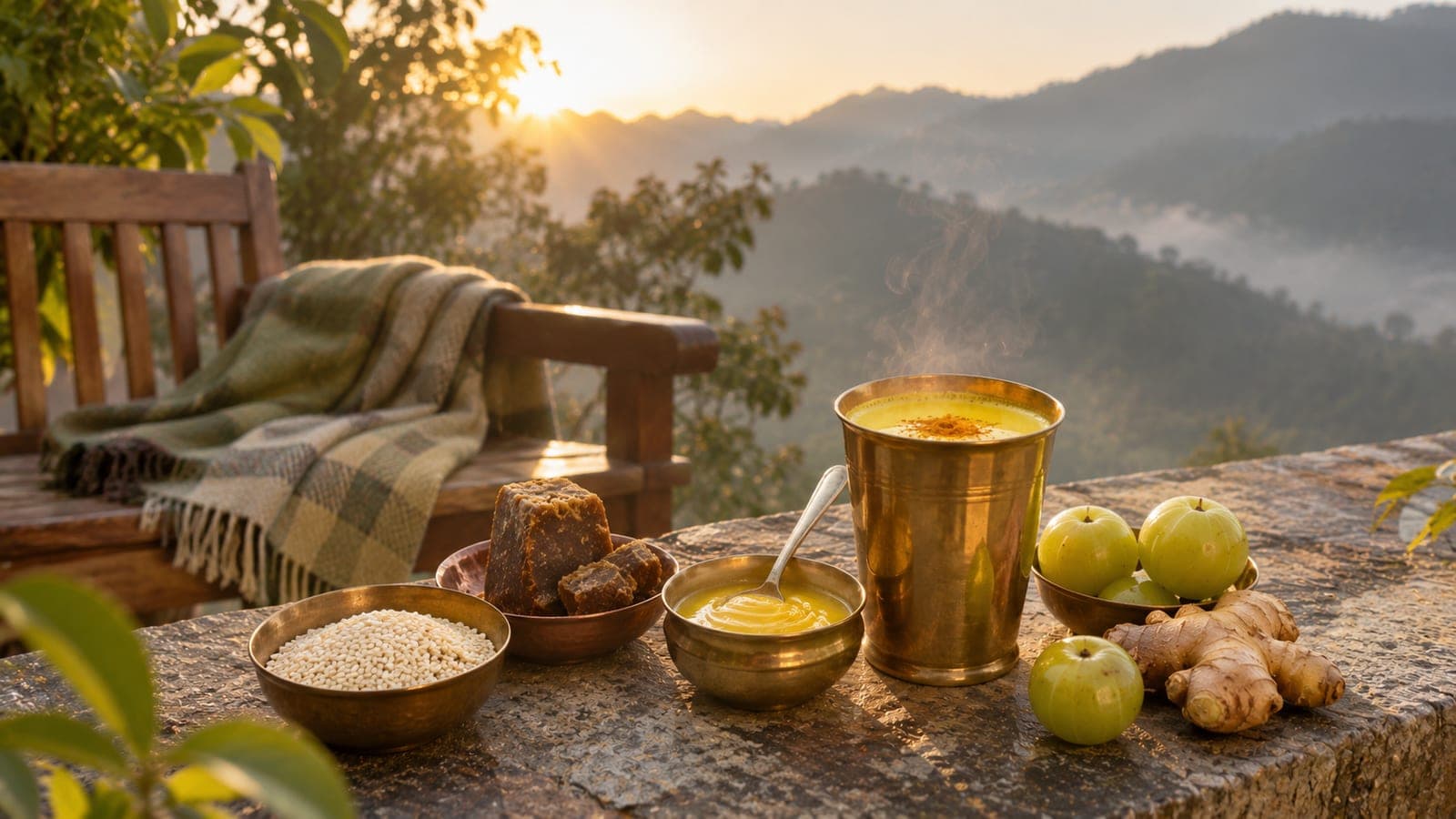
Heavier food is digested well. Ghee, sesame, jaggery, milk and dal, which would sit in you like a stone in July, are welcome now.
Too little food becomes a problem. This is the part people miss. The texts say plainly that a strong agni without enough fuel turns on the body's own tissues. In practical terms, that is vata aggravation: dry, cracking skin, stiff joints, constipation, light and broken sleep, a restless, anxious mind.
In other words, the characteristic winter mistake in Ayurveda isn't overeating. It is a crash diet in December.
If agni is a new idea to you, I've written about it at length in Agni: why Ayurveda treats digestion as the root of everything.
What happens to the doshas
| Dosha | In Hemanta | What to watch for |
|---|---|---|
| Pitta | Settles after autumn's aggravation | The September acidity and skin flares should be fading |
| Vata | Easily aggravated by cold, dry, wind and under-eating | Dry skin, stiff joints, constipation, poor sleep, worry |
| Kapha | Begins quietly to accumulate | Becomes March's heaviness, congestion and colds if winter eating isn't matched by movement |
The balance in this season is delicate: eat to satisfy a strong digestion and keep vata calm, but move enough that what you eat does not settle into spring kapha.
How to eat in Hemanta
The general direction is warm, cooked, nourishing and slightly unctuous, with sweet, sour and salty tastes favoured.
- Fats: ghee daily; sesame oil for cooking and for the body.
- Grains: wheat, new-season rice, bajra and makki in the north.
- Pulses: urad and moong dal; the heavier dals are well tolerated now.
- Sweeteners: jaggery rather than white sugar — gur, til-gur, chikki.
- Dairy: warm milk with a pinch of turmeric or nutmeg at night, if it suits you.
- Vegetables: roots and winter greens — carrot, beetroot, sweet potato, sarson, bathua, methi.
- Fruit: amla above all; oranges and guava in season.
- Spices: ginger, black pepper, cinnamon, clove, ajwain.
Reduce: cold drinks, iced desserts, raw salads at night, dry and puffed snacks, and very light or skipped meals.
I've written the full, practical kitchen version in a separate piece on Indian winter foods.
The daily routine
Abhyanga, every day if you can. Warm sesame oil over the whole body, ten minutes, followed by a warm shower. If there is one winter habit Ayurveda would insist on, this is it — it is the most direct answer to vata.
Udvartana. A dry massage with herbal powders, classically recommended in winter, to stimulate circulation and keep kapha moving.
Warm water. For bathing and drinking. Not scalding; comfortably warm.
Morning sun. Twenty minutes of early sunlight on the skin, which the texts recommend and which also helps set the body clock in the short days.
Exercise more. Winter is the one season when the texts permit vigorous exercise — up to about half of your capacity. This is your strongest training season of the year, not the one to hibernate through.
Dress warm. Cover the head, ears and feet at dawn and dusk.
Sleep. Nights are long and sleep comes easily; go with it, but avoid sleeping in the day, which dulls digestion.
Crossing from Sharad into Hemanta
The change of season doesn't happen on a date. The texts describe a junction — ritu sandhi — of roughly two weeks either side of the turn, during which you leave the habits of the old season gradually and take up the new ones gradually. Switching overnight from September's cooling diet to January's rich one is exactly the kind of abrupt change Ayurveda warns against.
In practice, for the second half of November:
- Keep some of the autumn's bitterness. A bitter vegetable a few times a week — methi, karela — while you start adding ghee, sesame and jaggery.
- Bring heavier foods in slowly. Urad dal and the richer winter sweets once or twice a week at first, at lunch, rather than every day.
- Start oiling before it's properly cold. Begin abhyanga in mid-November; by December you'll be glad of the habit.
- Warm your water. Move from room-temperature to warm drinking water as the mornings cool.
- Move earlier into the light. As the sun rises later, shift your outdoor time to whatever morning light there is.
The junction is also a time of slightly lowered resilience — the reason colds and coughs often arrive in late November. I've written about the September version of the same phenomenon in why you fall ill every September; the logic is identical at this end of autumn.
Signs your winter routine is working
You'll know within two or three weeks:
- appetite is steady and clean at lunchtime
- skin and lips stay soft rather than cracking
- joints loosen quickly in the morning
- sleep is deep and you wake with the light
- energy is even through the afternoon
If instead you feel heavy, congested and sluggish, you are eating more than you are moving — dial back the richest foods and move more. If you feel dry, stiff, anxious and sleep lightly, you are probably under-eating or skipping oil.
The therapies that suit early winter
With strong digestion and a body ready to build, Hemanta is well suited to:
- Oil-based therapies — abhyanga, pizhichil, shirodhara — that answer vata directly
- Rasayana — rejuvenative therapy and herbs, which classically follow a cleanse
- Many Panchakarma programmes, depending on the person; I've written about what really happens during Panchakarma
- Warm hydrotherapy and mineral immersion, with carefully dosed cold — the Kneipp tradition adapts to winter rather than stopping
Which of these is right for you depends on your constitution and condition, and that is a decision for a physician, not a blog post. Our Panchakarma Purification programme runs as a 14-night cycle, with a 21-night extended option.
Six things to do this week
- Oil your body with warm sesame oil before your shower, every morning.
- Make breakfast warm and real — no cold smoothies.
- Add a teaspoon of ghee to lunch.
- Swap white sugar for jaggery.
- Get twenty minutes of morning sun.
- Move hard once a day — a brisk walk, a climb, a proper yoga practice.
The season to build
Most of us treat winter as something to get through. Ayurvedically it is the opposite: the season the body is most willing to rebuild, and the best window of the year to put back what the summer and the festivals took out.
If you'd like someone to design that for you, speak to our physicians. Tell us how you've been sleeping, digesting and feeling since the weather turned — winter usually makes the answer clearer.
Key takeaways
- Hemanta is the season of greatest strength. Classical texts describe the body's strength and digestive power as highest in early winter.
- A strong agni with too little fuel turns on the body's own tissues and aggravates vata — dry skin, stiff joints, poor sleep. Under-eating is the season's characteristic mistake.
- Favour sweet, sour and salty tastes; warm, cooked, unctuous food; ghee, sesame, jaggery, milk, wheat, new rice and urad dal. Avoid cold, dry, light and raw food and long fasts.
- Daily abhyanga with warm sesame oil, warm-water bathing, morning sun and more vigorous exercise than in any other season are the core of the winter routine.
- Kapha quietly begins to accumulate in winter and flares in spring. Generous winter eating needs matching movement, or it becomes March's heaviness and colds.
Frequently asked
When is Hemanta Ritu?
Hemanta covers the lunar months of Margashirsha and Pausha, which in northern India falls roughly between mid-November and mid-January. It follows Sharad (post-monsoon autumn) and is followed by Shishir (late winter).
Why is digestion stronger in winter according to Ayurveda?
The classical explanation is that cold air outside constricts the surface of the body and keeps heat in the core, so agni — the digestive fire — burns more strongly. That is why heavier, more nourishing food is tolerated well in early winter and why the texts warn against under-eating.
What should I eat in Hemanta Ritu?
Warm, cooked, slightly oily food with sweet, sour and salty tastes: ghee, sesame, jaggery, milk and milk products, wheat, new rice, urad and moong dal, root vegetables, seasonal greens like sarson and bathua, amla and warming spices such as ginger, black pepper and cinnamon. Reduce cold drinks, raw salads, dry snacks and very light diets.
Which dosha is affected in early winter?
Pitta settles after the autumn. Vata is the dosha to watch, because cold and dry conditions aggravate it — especially if you under-eat. Kapha begins to accumulate through winter and tends to flare in spring, which is why winter eating must be balanced by daily movement.
Is winter a good time for Ayurvedic treatment?
Yes. With strong digestion and a body that is ready to build, early winter suits oil therapies, rejuvenation and many Panchakarma programmes, depending on the individual. Which procedures are right for you is a decision for a qualified physician after a consultation.
Written by
Rajesh Chada
Founder & CMD, The Ushmaya
Rajesh is the founder of The Ushmaya and the reason Kneipp hydrotherapy exists in India. He writes about water cure, Ayurveda and what genuine healing asks of you.
About Rajesh→A note on medical advice. This article is written for general understanding and is not a diagnosis or a treatment plan. Hydrotherapy, Panchakarma and fasting protocols are powerful and are not appropriate for everyone — particularly during pregnancy, or with cardiac, renal, circulatory or acute conditions. Every therapy at Ushmaya is prescribed after a consultation with our resident physicians. Please speak to your own doctor before changing how you treat a diagnosed condition.