
Food as Medicine
Agni: Why Ayurveda Treats Digestion as the Root of Everything

By Rajesh Chada · Founder & CMD, The Ushmaya
18 September 2026 · 7 min read
A guest arrived last spring with a shopping bag of supplements. Twenty-two bottles. Three types of magnesium, four adaptogens, collagen, two probiotics, a greens powder and a liver support formula. She had bloating, fatigue, poor skin and a coated tongue, and she wanted to know what to add.
Our physician looked at the bag for a while and said: nothing. Stop all of it for ten days and eat khichdi.
She was, briefly, furious. She was also entirely better by the end of the week — and the reason is the single most important idea in Ayurvedic medicine.
Food is not nourishment until it is digested
Agni means fire. In Ayurveda it is the whole transformative capacity of the body — the force that converts food into tissue, perception into understanding, experience into memory. The digestive form, jatharagni, is where it is most tangible.
The claim is simple and radical: what you eat matters less than what you can digest. A superb meal entering a weak digestion does less good than a plain one entering a strong digestion — and the surplus does active harm, because undigested food does not pass through harmlessly. It becomes ama.
Ama is sticky, incompletely metabolised residue. It circulates. It settles in tissue and in channels — srotas — and blocks them. And in the Ayurvedic model, the great majority of chronic disease begins there: obstruction and accumulation, rather than deficiency.
Which inverts the modern instinct. Faced with fatigue, the modern reflex is to add. The Ayurvedic reflex is to ask what is blocked and remove it.
Remarkably, that is close to where gut science has arrived independently: a compromised intestinal barrier, disordered microbiome and low-grade systemic inflammation now sit behind a long list of conditions that look nothing like digestive disease — autoimmune disease, metabolic syndrome, skin conditions, mood disorders. Some 70% of immune tissue surrounds the gut. The vagus nerve runs between gut and brain in both directions, mostly upward. Different vocabulary; the same organ at the centre of the picture.
How to read your own agni
Ayurveda describes four states. Most people recognise themselves immediately.
Sama agni — balanced. Hunger arrives at predictable times, roughly every four to six hours. You eat, feel comfortably satisfied, feel light again after an hour. One easy bowel movement a day, in the morning. Clear tongue, clean breath, steady energy, good sleep. This is the target.
Vishama agni — irregular (vata pattern). Appetite comes and goes. Bloating and gas, especially afternoon. Alternating constipation and loose stools. Gurgling. Variable energy, anxiety, disturbed sleep. The commonest pattern in anyone who travels, works irregular hours or eats at a desk.
Tikshna agni — sharp (pitta pattern). Ravenous, frequently. Irritable if a meal is late. Acidity, reflux, burning. Loose, urgent stools. You digest food fast and burn through it. This is September's pattern — see the Sharad Ritu guide for why it spikes post-monsoon.
Manda agni — slow (kapha pattern). Little appetite, but you eat anyway. Heavy and sleepy after meals. Slow, sluggish digestion. Mucus, a thickly coated tongue, weight that will not move, morning grogginess. The dominant monsoon pattern.
And the signs of ama itself, regardless of pattern: a thick white or yellow coating on the tongue in the morning, bad breath, a heavy body, aching with no cause, brain fog, no appetite at breakfast, and that specific unrefreshed feeling after a full night's sleep. Look at your tongue tomorrow morning before you brush. It is the cheapest diagnostic you own.
The ten habits that repair it
Almost none of this is about ingredients. It is about how.
1. Eat only when hungry. Genuinely. Not at mealtimes out of habit, not because it's there. Real hunger is the signal that agni has finished the previous job. Eating on top of undigested food is the primary manufacturing process for ama.
2. Leave four hours between meals. No grazing. Constant snacking means agni never completes a cycle. This single change resolves more bloating than any supplement.
3. Make lunch the largest meal. Digestive capacity peaks at midday. Eating your heaviest meal at 9pm is asking a fire to do its hardest work when it is lowest.
4. Eat to three-quarters full. Classical Ayurveda is specific: half the stomach for food, a quarter for liquid, a quarter left empty for the process itself. Nothing digests in a full container.
5. Warm and cooked over cold and raw. Cold food and cold drink damp down agni directly. A large raw salad with iced water is, by this logic, one of the harder meals to digest — not one of the easier ones. Sip warm water with food.
6. Sit down, and put the screen away. Digestion is parasympathetic. Eating while working keeps you sympathetic, and the enzymes genuinely do not arrive in the same quantity. This is not a metaphor.
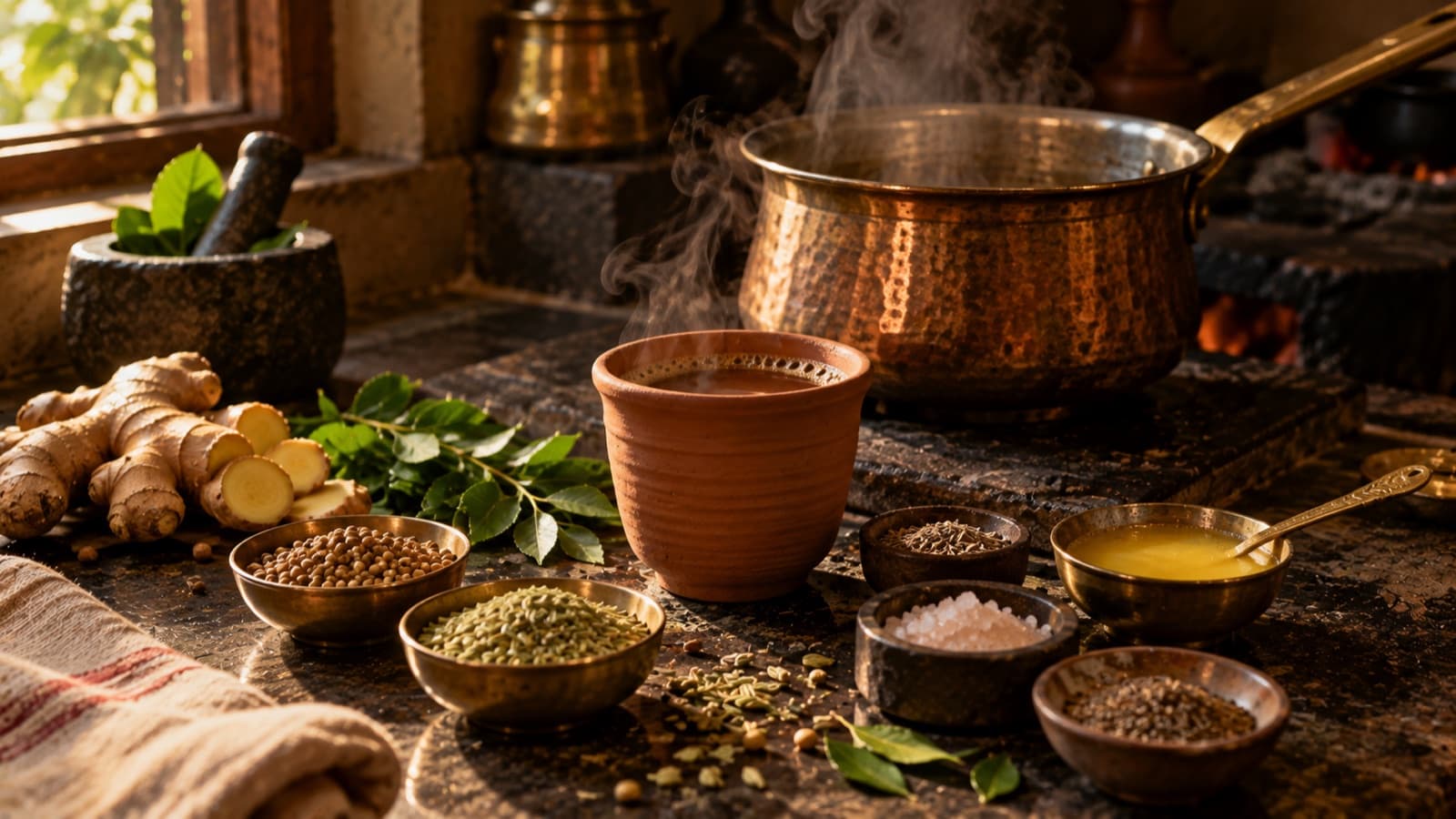
7. Use the digestive spices. Cumin, coriander, fennel, ginger, ajwain, black pepper, hing. The classic tadka exists for a reason. Fresh ginger with a pinch of rock salt before a meal stimulates sluggish agni; fennel and coriander cool a sharp one.
8. Walk a hundred steps after eating. Shatapavali. Not a workout — a short, slow walk. Then do not lie down for two hours, and never sleep on a full stomach.
9. Fix the clock before the food. Agni is circadian. Eating at the same times daily does more for irregular digestion than any change of diet.
10. Give it a rest. One light day a week — khichdi, soup, fruit — lets a working digestion catch up. This is langhana, lightening, and it is the oldest therapeutic intervention in the book.
Khichdi, and why it keeps appearing
Split yellow moong dal, rice, ghee, cumin, turmeric, cooked soft. It appears on almost every Ayurvedic protocol in existence, including ours, and guests are always slightly disappointed by it.
It is there because it is the only food that is simultaneously light enough to digest when agni is weak and complete enough to live on. Moong is the most digestible pulse there is. Rice and dal together make a full protein. Ghee carries the spices into tissue and protects the gut lining. And it asks almost nothing of the system — which is precisely what you want when the system is the problem.
A mono-diet of khichdi for three to seven days is the standard clearing protocol for ama, and it is where we start most gut restoration work. It is also why people are surprised by how simple retreat food is.
Where clinical work begins
Habits handle a great deal. They do not handle everything.
When ama has accumulated over years and lodged in tissue, dietary change alone will not shift it — and this is the point of Panchakarma. The sequence is deliberate: deepana and pachana first (kindling digestion and metabolising residue), then snehana and swedana (oleation and sudation, to mobilise what is stuck), then the main eliminative procedure, then a graded rebuilding. Skip the preparation and you are mobilising nothing; the procedure becomes theatre.
Autumn is the classically indicated season for the pitta-clearing version of this. What it actually involves, day by day, is in what really happens in Panchakarma.
Hydrotherapy has a real role here too, which surprises people. Warm abdominal compresses and liver packs increase local circulation and are among the most reliably sedating things we do; cold abdominal applications stimulate peristalsis. Kneipp used both constantly for digestive complaints, long before anyone had mapped the gut-brain axis. The wider framework is in our guide to hydrotherapy.
Start with one thing
Not the supplements. Not a new diet.
Leave four hours between meals for a week, and make lunch the biggest one. That's it. Then look at your tongue each morning and watch the coating.
If it clears, you have your answer about what the problem was. If it doesn't, it's worth finding out why rather than adding another bottle — talk to our physicians.
Written by
Rajesh Chada
Founder & CMD, The Ushmaya
Rajesh is the founder of The Ushmaya and the reason Kneipp hydrotherapy exists in India. He writes about water cure, Ayurveda and what genuine healing asks of you.
About Rajesh→A note on medical advice. This article is written for general understanding and is not a diagnosis or a treatment plan. Hydrotherapy, Panchakarma and fasting protocols are powerful and are not appropriate for everyone — particularly during pregnancy, or with cardiac, renal, circulatory or acute conditions. Every therapy at Ushmaya is prescribed after a consultation with our resident physicians. Please speak to your own doctor before changing how you treat a diagnosed condition.