
Food as Medicine
How to Eat Through Diwali Without Wrecking Your Digestion
By Rajesh Chada · Founder & CMD, The Ushmaya
5 November 2026 · 7 min read
In short
To eat through Diwali without digestive trouble, have sweets and fried snacks at midday when digestion is strongest, keep dinner light and early, leave four hours between meals, sip warm water instead of cold drinks, and finish heavy meals with fennel. Ayurveda's concern is not the sweet but eating on top of undigested food.
Every year the week after Diwali brings the same calls. Acidity, bloating, a heavy head, sleep that has gone strange, and a slightly sheepish admission that the person "didn't even eat that much".
They usually didn't. What they did was eat a little, often, late, and cold-on-top-of-heavy for five days running. Ayurveda has a precise vocabulary for why that goes wrong, and a precise, mostly free, answer.
This is not a guide to skipping the sweets. I have no intention of skipping the sweets.
Why festive food sits so heavily
In Ayurvedic terms, digestion is governed by agni — the digestive fire — and its strength rises and falls through the day. It is strongest around midday and weakest late at night. I've explained the idea properly in Agni: why Ayurveda treats digestion as the root of everything.
Diwali food is, almost by definition, guru — heavy. Ghee, sugar, khoya, refined flour, deep-fried namkeen. Heavy food is not a problem for a strong agni at the right time of day. It becomes a problem when:
- it is eaten late, when digestion is at its weakest
- it is eaten on top of a meal that has not been digested yet
- it is chased with something cold, which dampens digestion further
When all three happen, the meal is not fully digested, and the residue — ama in Ayurvedic language — is what you feel the next morning as a coated tongue, heaviness and poor appetite.
When should you eat the sweets?
Midday. This is the one change that does the most.
Make lunch your festive meal, and have your sweet as part of it or shortly after. Your digestion is at its strongest between roughly 11am and 2pm. Then keep the evening light: a simple dinner before 8pm, even on Diwali night, and the mithai box closed after that.
I know Lakshmi Puja is an evening ritual and the prasad comes at night. Take the prasad — a small piece is prasad; half the box is not. Eat the rest at lunch the next day.
The four-hour rule
The biggest single cause of festive bloating is not one big meal. It is grazing.
A ladoo at a neighbour's at 11, kachori at 12.30, lunch at 2, chakli with tea at 4.30, a few barfis at 6, dinner at 9. None of it individually is excessive. But the stomach never gets to finish anything.
Ayurveda's rule is simple: don't eat again until you are actually hungry, which for most people means about four hours after a proper meal. If you must accept something when visiting — and in India you must — take a small piece and let it be the snack, rather than an addition to three others.
What to drink
| Drink | Verdict | Why |
|---|---|---|
| Warm water, sipped | Yes, all day | Supports digestion; the simplest remedy there is |
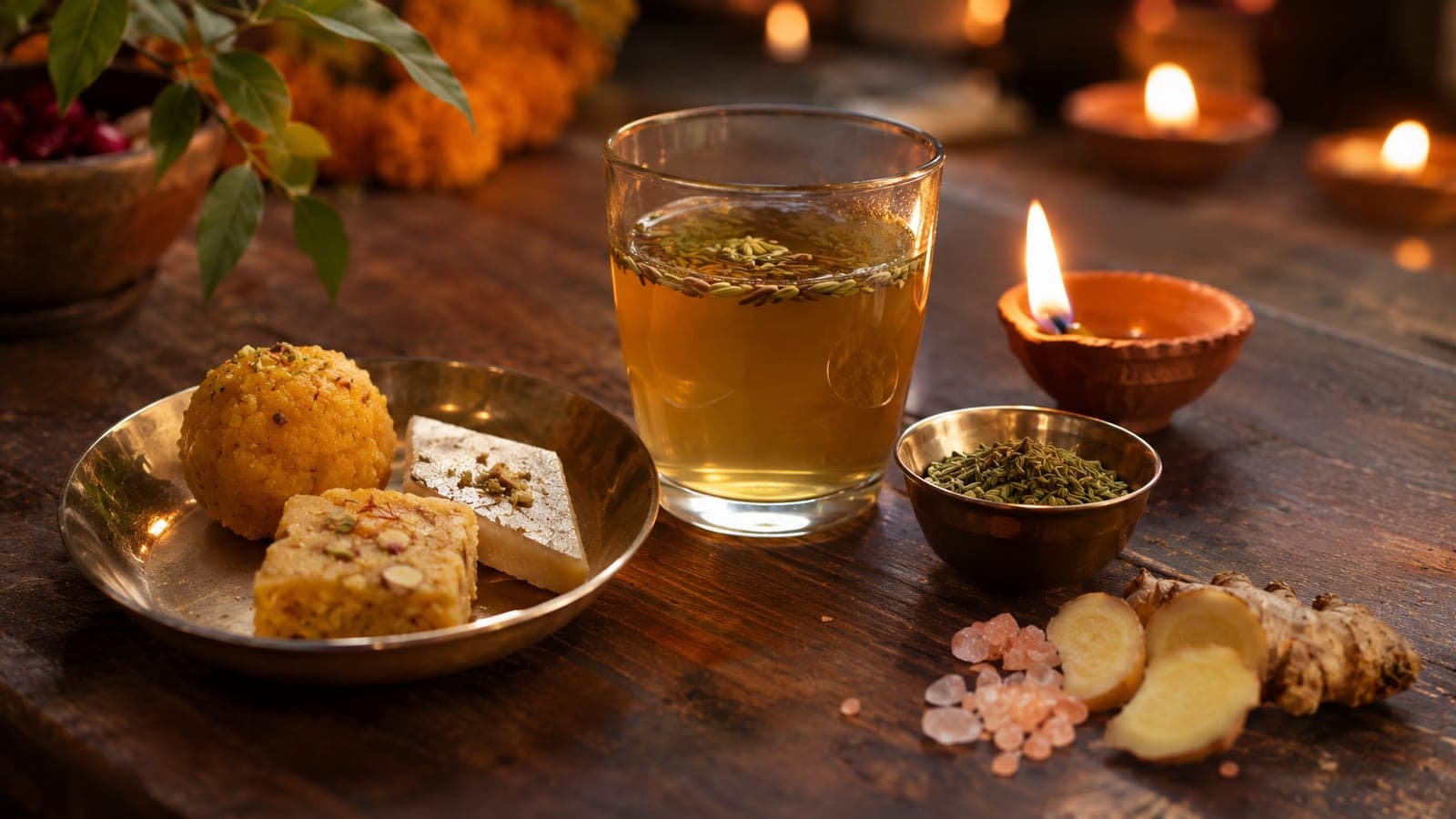
| Cumin–coriander–fennel water | Yes | Gentle, carminative; boil a teaspoon of each in a litre of water |
| Thin buttermilk with roasted cumin | Yes, at lunch | Classical digestive with a meal; avoid at night |
| Ginger tea | Yes, in moderation | Warming and appetising; go easy if you're prone to acidity |
| Iced water, cold drinks | Avoid with heavy food | Cold on top of fat and sugar slows digestion |
| Fizzy drinks | Avoid | Sugar plus gas plus cold |
| Alcohol | Least is best | Adds load to digestion and sleep at the worst time of day |
Three remedies to keep on the counter
Before a heavy meal: ginger with rock salt. A thin slice of fresh ginger with a pinch of rock salt and a few drops of lemon, chewed ten minutes before eating. This is the classical appetiser in Ayurveda and it is hard to improve on.
After a meal: fennel. A small spoon of fennel seed, chewed slowly. Every Indian restaurant hands you a bowl of it at the door for a reason.
Through the day: CCF water. Boil a teaspoon each of cumin, coriander and fennel seed in a litre of water for five minutes, strain, and keep it in a flask. Sip it warm.
None of these will rescue a seven-course midnight feast. All three make an ordinary festive day noticeably lighter.
How to build a festive day that works
- Morning: warm water on waking; a light breakfast — or none, if you are not hungry after last night.
- Late morning: visits and pujas. Accept sweets, eat small pieces, drink warm water.
- Lunch (12–2pm): the real meal. This is where the puri, the sabzi, the kheer and the special sweet belong.
- Afternoon: a walk, even twenty minutes. Movement after the main meal helps digestion more than lying down.
- Evening: a cup of CCF water or herbal tea instead of a snack plate.
- Dinner (before 8pm): light and warm — dal, a sabzi, a roti, or a bowl of soup.
- Night: prasad, fireworks, and bed earlier than you think you'll manage.
If you have diabetes, acidity or a sensitive gut
The general advice above holds for most healthy people. Three groups need a little more care over the festival.
If you have diabetes or prediabetes. Festive sweets are a real problem, not a matter of timing alone. The Ayurvedic advice to eat sweets at midday still helps — you are more active afterwards — but quantity matters most. Decide in advance how many pieces you will have in the day, take them with a meal rather than on an empty stomach, walk for fifteen minutes after eating, and keep up your normal monitoring and medication. "It's only once a year" is true of Diwali and untrue of the five days around it. Our Diabetes Reversal & Management programme exists because this balance is hard to strike alone.
If you are prone to acidity. Fried food, sour pickles, strong tea and coffee, alcohol and very spicy namkeen are the usual triggers. Keep ginger to small amounts, favour fennel and coriander over chilli, don't lie down within two or three hours of eating, and have a little cool — not iced — milk or buttermilk at lunch if it suits you. If you need an antacid every day of the festival, that is worth discussing with a doctor afterwards.
If you have a sensitive gut. Bloating and loose stools after festive food often come from large quantities of fried and refined-flour snacks, and from many different foods mixed in one sitting. Ayurveda is wary of viruddha ahara — incompatible combinations — and one of the most common festive ones is milk sweets eaten together with salty, sour or fried snacks. Keep the milk sweets separate from the namkeen plate, and keep portions small.
For everyone: if something feels wrong rather than just heavy — real pain, vomiting, blood, or symptoms that don't settle — see a doctor. That is not a digestion-strength problem.
What if it has already gone wrong?
Then the next day is khichdi.
Moong dal and rice cooked soft with a little ghee, cumin and ginger, eaten warm, two or three times that day. It is the food Ayurveda uses precisely when digestion has been overloaded — light enough to give agni a rest, nourishing enough not to leave you starving. I wrote about why khichdi is the backbone of retreat food in what's actually on the plate at a wellness retreat.
What not to do: skip meals all day and then eat everything at 10pm, or launch a juice cleanse with three festival days still to go. Both weaken digestion further and tend to end in a bigger binge.
Persistent acidity, pain, vomiting or any change that does not settle in a few days is a reason to see a doctor, not to try harder remedies.
After the festival
The week after Diwali is a natural moment for a reset — not a punishment, a reset. I'll write separately about a gentle post-festival routine. If you would rather someone else took charge of it, our Gut Health & Digestive Restore programme is built for exactly that, and the shorter Detox Refresh package was designed with post-festive recovery in mind.
In the meantime: eat the sweets at lunch. Happy Diwali.
If your digestion has been troubling you for longer than a festival, talk to our physicians. It's a conversation, not a sales call.
Key takeaways
- Ayurveda's rule for feasting is about timing, not abstinence: the heaviest food at midday, when agni is strongest, and nothing heavy after sunset.
- The single biggest cause of festive bloating is grazing — eating again before the last thing has been digested. Leave roughly four hours between meals.
- Warm water through the day; no iced drinks with heavy food. Cold liquid on top of ghee and sugar is the most efficient way to make a feast sit in you.
- Fennel after meals, a thin slice of ginger with rock salt before them, and cumin-coriander-fennel water during the day are the three remedies worth keeping on the counter.
- If one day goes badly, make the next day khichdi. Do not skip meals and do not start a juice fast in the middle of the festival.
Frequently asked
What is the Ayurvedic way to eat sweets during Diwali?
Eat them earlier rather than later — ideally as part of or just after lunch, when digestion is strongest — and eat them in place of something, not on top of everything. A sweet after a light lunch is well tolerated. The same sweet at 10pm after a heavy dinner and a plate of namkeen is what causes trouble.
How do I stop acidity and bloating during the festival?
Space meals about four hours apart, avoid cold drinks with heavy food, keep dinner light and early, and chew a little fennel after meals. A thin slice of fresh ginger with a pinch of rock salt and a few drops of lemon, taken before a heavy meal, is the classical appetiser. If acidity persists or is severe, see a doctor.
Should I fast before or after Diwali to compensate?
Not in the middle of it. A hard fast between feast days tends to produce a bigger binge and a weaker digestion. If you overdo it, follow the next day with simple, warm, light food — moong dal khichdi with a little ghee — and let your appetite come back on its own.
Is ghee in sweets bad for digestion?
Ghee itself is well regarded in Ayurveda and easier to digest than many other fats. The problem in festive food is the quantity and combination — ghee, sugar, refined flour and deep frying together, eaten late and often. In moderation, home-made sweets with good ghee are not the enemy.
What drinks help digestion after a heavy meal?
Warm water sipped slowly, a cup of cumin-coriander-fennel water, or thin buttermilk with roasted cumin at lunchtime. Avoid fizzy drinks, iced water and alcohol with heavy food.
Written by
Rajesh Chada
Founder & CMD, The Ushmaya
Rajesh is the founder of The Ushmaya and the reason Kneipp hydrotherapy exists in India. He writes about water cure, Ayurveda and what genuine healing asks of you.
About Rajesh→A note on medical advice. This article is written for general understanding and is not a diagnosis or a treatment plan. Hydrotherapy, Panchakarma and fasting protocols are powerful and are not appropriate for everyone — particularly during pregnancy, or with cardiac, renal, circulatory or acute conditions. Every therapy at Ushmaya is prescribed after a consultation with our resident physicians. Please speak to your own doctor before changing how you treat a diagnosed condition.