
Food as Medicine
Winter Immunity: Chyawanprash, Haldi and What the Evidence Really Says

By Rajesh Chada · Founder & CMD, The Ushmaya
24 November 2026 · 6 min read
In short
The most reliable ways to support immunity in winter are sleep, regular movement, a varied diet with enough protein and fresh produce, and recommended vaccinations. Ayurvedic staples such as amla, ginger, tulsi, turmeric and chyawanprash can be sensible parts of a winter diet, but none has strong evidence that it prevents infections on its own. Think support, not shield.
Every November the pharmacy counters and supermarket shelves rearrange themselves. Chyawanprash moves to eye level. Immunity shots, turmeric capsules, giloy tablets and "kadha" sachets crowd round the billing counter.
Some of these traditions are genuinely sensible. But the conversation around them has become so loud that it drowns out the plain truth: most of what keeps you well through winter happens in your bedroom, on your feet and on your plate — not in a jar.
Here's an honest guide to both.
What actually supports immunity
The evidence-backed foundations are unglamorous:
- Sleep. Short or poor sleep is consistently linked to a higher risk of catching infections. Seven to nine hours for most adults.
- Movement. Regular moderate exercise supports immune function. Winter is the season to keep moving, not hibernate.
- A varied, adequate diet. Enough protein, plenty of vegetables and fruit, enough calories. Under-eating weakens defences.
- Vaccinations. Your doctor can tell you whether the seasonal flu vaccine and others are advisable for you.
Add to those: not smoking, limiting alcohol, getting some daylight, washing hands and managing stress. That's the base. Everything else is a supplement to it, in both senses.
What Ayurveda means by immunity
Ayurveda's word for immunity is vyadhikshamatva — the capacity to resist disease. It's not located in any single herb. It comes from:
- strong agni, so food is properly digested and turned into healthy tissue
- good-quality dhatus (tissues), built from that digestion
- ojas, the essence of vitality those tissues produce
- a routine that suits the season, with enough sleep and moderation
That framing has aged well. It puts digestion, routine and sleep at the centre, and treats herbs as support. I've written about the digestive side in Agni: why Ayurveda treats digestion as the root of everything, and about the seasonal side in why you fall ill every September.
The traditional winter staples, honestly
| Food or remedy | Traditional role | What we can honestly say |
|---|---|---|
| Amla | The great rasayana fruit | A genuinely rich source of vitamin C; a good daily winter fruit |
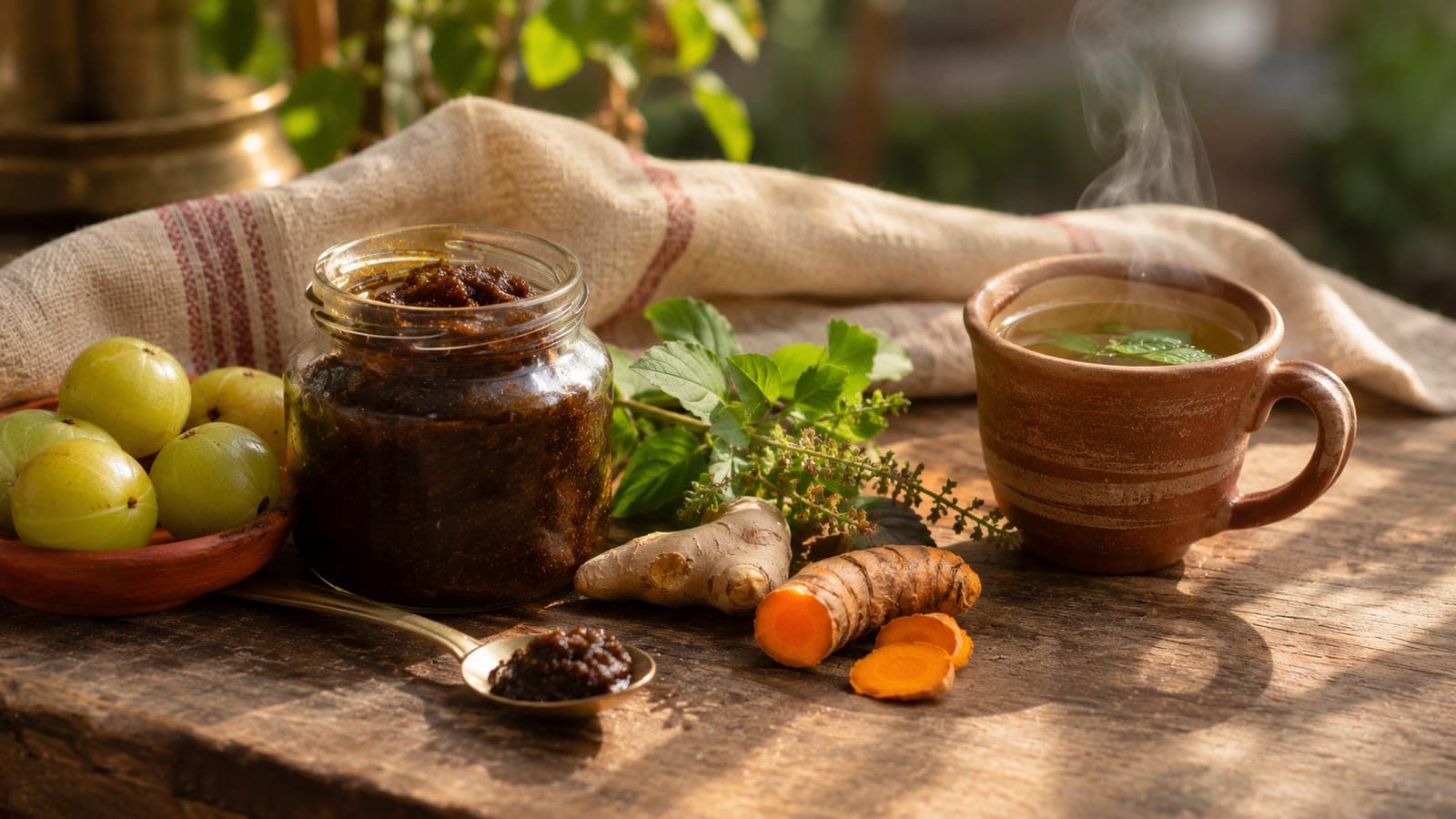
| Chyawanprash | Classical winter rasayana built on amla | Reasonable in small amounts for most people; high in sugar; limited strong evidence it prevents infections |
| Turmeric (haldi) | Warming, anti-inflammatory | Widely studied; curcumin is poorly absorbed alone — use in food with black pepper and fat |
| Ginger (adrak) | Warming, supports digestion | Good in tea and food; helpful for nausea; go easy if prone to acidity |
| Tulsi | Revered for respiratory health | A pleasant, traditional tea; research is early and limited |
| Giloy | Used for fevers and immunity | Take only on a practitioner's advice; there have been reports of liver problems with some giloy use |
| Honey | Soothing for coughs and sore throats | Reasonable evidence for easing cough symptoms; never for babies under one; Ayurveda advises against heating it |
| Kadha (spiced herbal decoction) | Warming winter drink | Comforting and traditional; very strong versions can irritate the stomach |
How to use them sensibly
Amla daily. Raw with a pinch of salt, as murabba in moderation, as chutney, or in juice diluted with water. Of everything on the list, this is the easiest win.
Chyawanprash in small amounts. A teaspoon in the morning with warm water or milk, for most healthy adults. Read the label — it's often more than half sugar.
Turmeric in cooking. In your dal and sabzi, cooked in a little fat, with black pepper. A cup of haldi doodh at night if you enjoy it.
Ginger-tulsi tea. A few slices of fresh ginger and a handful of tulsi leaves simmered for five minutes. Add honey once it has cooled to drinking temperature.
Warm, cooked, seasonal food. Which is the real Ayurvedic immunity prescription — the full list is in our piece on Indian winter foods.
A winter day that supports immunity
Putting the evidence and the tradition together, a day that does the most for your defences looks something like this:
- 6.30–7am: wake at a regular time; a glass of warm water
- Morning: twenty minutes outdoors in the light — a brisk walk if the air quality allows, indoor movement if it doesn't
- Before your bath: warm sesame oil massage
- Breakfast: warm and substantial — daliya, poha with vegetables, a besan chilla, eggs if you eat them
- Mid-morning: an amla, or a guava or orange
- Lunch, the main meal: dal, a vegetable, a grain, a little ghee, turmeric and black pepper in the cooking
- Afternoon: ginger-tulsi tea instead of a fourth cup of chai; no caffeine after about 2pm
- Dinner, early and warm: soup, khichdi, or a lighter version of lunch
- Night: screens away, a cool bedroom, seven to nine hours of sleep
Notice that nothing on that list is expensive or unusual. That's rather the point.
Children and older family members
Winter illness falls hardest at the two ends of life, and both need a slightly different approach.
Children need sleep, outdoor play when the air allows, a varied diet and their scheduled vaccinations above anything else. Many Indian families give children a little chyawanprash in winter; if you do, use a small amount and remember the sugar. Herbal supplements and concentrated kadhas are not designed for children's doses — ask your paediatrician first. And again: no honey before the first birthday.
Older adults are more vulnerable to winter infections and their complications. Ask the doctor about seasonal flu and other recommended vaccines. Keep them warm, well fed and moving — muscle loss and under-eating both weaken resilience. Take particular care with supplements if they are on several medicines, because interactions are more likely.
For both, the warning signs that need prompt medical attention are the same: high or persistent fever, breathlessness, unusual drowsiness or confusion, and not eating or drinking.
Cautions worth stating clearly
- Never give honey to a baby under one year old.
- Chyawanprash and honey are sugar. If you have diabetes or prediabetes, discuss them with your doctor.
- Herbal supplements can interact with medicines, including blood thinners and diabetes and blood pressure drugs. Check first.
- Concentrated supplements are not the same as food. High-dose turmeric, giloy and others are not risk-free.
- Get real symptoms looked at. A high or persistent fever, breathlessness, chest pain or an illness that keeps getting worse needs a doctor, not a stronger kadha.
The winter that keeps you well
If I had to compress it: sleep early, get up with the light, oil your skin, move every day, eat warm cooked food at regular times, have an amla, and go easy on everything that comes in a sachet.
That's also, more or less, what a week at a good retreat looks like: the routine is the treatment. If your winters have become a run of one infection after another, our physicians can look at what's underneath it. The 7-Day Deep Healing Retreat is a good place to reset the routine, and the Gut Health & Digestive Restore programme goes deeper if digestion is the weak link.
Book a consultation and tell us what your winters have been like.
Key takeaways
- Sleep, movement, nutrition and vaccination do the heavy lifting for immunity. Nothing in a jar outperforms them.
- Amla is a genuinely rich source of vitamin C and a sensible daily winter fruit. Chyawanprash, built on amla, is a traditional winter rasayana — but it also contains a lot of sugar.
- Turmeric is best in food, with black pepper and fat. Curcumin on its own is poorly absorbed, and high-dose supplements aren't risk-free.
- Ayurveda's idea of immunity — vyadhikshamatva — is about strong digestion and steady routine more than about any single herb. That framing holds up well.
- Children under one should never be given honey, people with diabetes should count chyawanprash as sugar, and anyone on medication should check before adding herbal supplements.
Frequently asked
How can I boost my immunity naturally in winter?
Prioritise seven to nine hours of sleep, move every day, eat a varied diet with enough protein and plenty of vegetables and fruit, get some daylight, manage stress, avoid smoking and limit alcohol, and keep up recommended vaccinations such as the seasonal flu vaccine if your doctor advises it. Traditional foods like amla, ginger and tulsi can be part of that diet.
Does chyawanprash really boost immunity?
Chyawanprash is a traditional Ayurvedic rasayana made from amla, herbs, ghee, honey and sugar, and many people take it through winter. Some small studies suggest possible benefits, but there isn't strong clinical evidence that it prevents colds or infections. It's a reasonable traditional food for most healthy people in small amounts, but it is high in sugar.
Is turmeric milk good for immunity?
Haldi doodh is a comforting traditional winter drink and fine for most people. Turmeric's active compound, curcumin, has been widely studied for its anti-inflammatory effects, but it is poorly absorbed on its own and evidence that it prevents infections is limited. Adding a pinch of black pepper and having it with fat, as in milk, helps absorption.
What does Ayurveda say about immunity?
Ayurveda describes immunity as vyadhikshamatva — the capacity to resist disease — and links it closely to strong agni (digestion), good-quality tissue and ojas, the essence of vitality. Its approach is mainly seasonal routine, good digestion, sleep and moderation, with rasayana foods and herbs as support.
Can I take chyawanprash if I have diabetes?
Regular chyawanprash contains a substantial amount of sugar, so people with diabetes should check with their doctor before taking it and count it as part of their carbohydrate intake. Sugar-free versions exist, but check their ingredients.
Written by
Rajesh Chada
Founder & CMD, The Ushmaya
Rajesh is the founder of The Ushmaya and the reason Kneipp hydrotherapy exists in India. He writes about water cure, Ayurveda and what genuine healing asks of you.
About Rajesh→A note on medical advice. This article is written for general understanding and is not a diagnosis or a treatment plan. Hydrotherapy, Panchakarma and fasting protocols are powerful and are not appropriate for everyone — particularly during pregnancy, or with cardiac, renal, circulatory or acute conditions. Every therapy at Ushmaya is prescribed after a consultation with our resident physicians. Please speak to your own doctor before changing how you treat a diagnosed condition.